Slurred Speech: Causes and When It’s an Emergency
Slurred speech that starts suddenly can be a stroke: call your local emergency number at once (999 in the UK, 911 in the US), even if it stops. Slurring that builds up gradually can be dysarthria, linked to conditions such as Parkinson’s or MS; see a doctor and ask about an SLP.
Sudden slurred speech: call emergency services
If speech changes suddenly
If someone’s speech suddenly becomes slurred or garbled, especially if their face droops on one side or they can’t lift both arms and keep them there, it can be a stroke, which is a medical emergency. Call your local emergency number straight away: the NHS says 999 in the UK, and MedlinePlus says 911 in the US. Don’t wait to see if it passes.
Stroke symptoms can sometimes stop after a short time, so you may think you’re fine. The NHS says to get medical help straight away even so, and to call 999 if you’ve had signs of a stroke in the last 24 hours, even if they’ve stopped. The Stroke Association adds that short-lived symptoms could be a transient ischaemic attack (TIA, or mini-stroke), which still needs urgent help.1,9
The NHS says not to drive yourself to A&E. The US National Heart, Lung, and Blood Institute (NHLBI) advises calling an ambulance rather than driving, so that medical personnel can begin treatment on the way to the emergency room.1,8
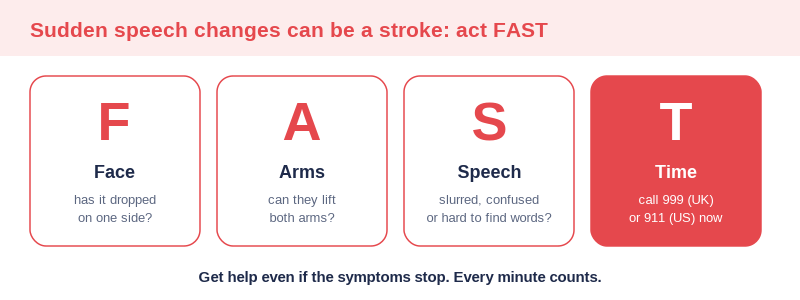
Stroke warning signs
The NHS uses the word FAST to remember the main signs: face, arms, speech, and time to call 999. For speech, the Stroke Association asks whether the person can speak clearly and understand what you say, and whether their speech is slurred, as the FAST diagram above sets out.1,9
Slurring isn’t the only speech sign. The NHS also lists sounding confused and finding it difficult to speak or think of words, and MedlinePlus lists sudden confusion and trouble speaking or understanding speech. The Stroke Association says any one of the FAST signs is an emergency, and MedlinePlus says every minute counts.1,3,9
Stroke signs often occur quickly, but the NHLBI notes they can also develop over hours or even days. Researchers have proposed adding Balance and Eyes to the mnemonic (BE-FAST) as a more comprehensive tool, and one study found that FAST failed to detect 14% of ischaemic strokes.8,16
Other causes of slurred speech
ASHA explains that dysarthria happens when brain or nerve damage changes the way your muscles work, which can make speech sound slow, slurred or hard to understand. The UK stroke guideline describes dysarthria as a motor speech impairment with slow, weak, imprecise or uncoordinated movements, and says the speech is usually described as slurred or blurred.5,11
ASHA says anything that damages the brain or nerves can lead to dysarthria. Its list includes stroke, brain injury, Parkinson’s disease, multiple sclerosis, amyotrophic lateral sclerosis (ALS), cerebral palsy, Huntington’s disease, muscular dystrophy, spinal cord injury and tumours.5
| Condition | ASHA Practice Portal estimate |
|---|---|
| Parkinson’s disease | approximately 44%–88% of people |
| Multiple sclerosis | 40%–51% diagnosed with dysarthria at some point |
| Acute stroke | 22%–58% of people |
| Acute to subacute traumatic brain injury | approximately 30%–86% of people |
How often adults with some conditions have dysarthria, as estimated in ASHA’s Practice Portal4
ASHA notes that some people with dysarthria also have other speech or language challenges, such as apraxia of speech or aphasia, and that speech may be harder to understand when you’re tired.5
Slurred speech that comes on slowly
The NHS says to see a GP if you’ve noticed gradual changes to your speech and you’re worried, and ASHA advises seeing a doctor right away if you notice any new difficulty talking.2,5
The US National MS Society says a person with MS may not notice their own speech problems, and that many times a family member or doctor brings it up. Parkinson’s UK says you might notice you are speaking more slowly or more quickly without trying to.13,12
The signs ASHA describes include people having trouble understanding your words, slurring or mumbling, talking too slowly or too fast, and talking too quietly or too loudly.5
These are things to mention to a doctor, not something to score yourself on.
When to see an SLP
Once a doctor has checked a change in your speech, ask about a speech-language pathologist (SLP), known in the UK as a speech and language therapist. The National MS Society describes the SLP as the specialist who can best diagnose and treat speech problems. SpeechStep’s find support page explains how to find an SLP through your country’s register.
How slurred speech is assessed
After a stroke, NICE recommends screening for communication difficulties within 72 hours and referring anyone with suspected difficulties to an SLP for detailed assessment. The UK stroke guideline says people with unclear speech after stroke should be assessed by an SLP so the problem can be diagnosed and explained to them and their family.10,11
Part of the assessment is telling dysarthria apart from other problems. ASHA explains that aphasia affects understanding and expressing language, while dysarthria affects only speech production. NIDCD describes apraxia of speech as difficulty planning speech movements, not weakness of the speech muscles.4,7
ASHA describes several types of dysarthria, such as flaccid, spastic, ataxic and hypokinetic, each associated with a different part of the nervous system. It says choosing the right strategies depends on the cause, the differential diagnosis of dysarthria type and which parts of speech are affected.4
Speech therapy for slurred speech
ASHA says your work with an SLP depends on the type of dysarthria and how much of a problem it is for you, and lists work such as slowing down, talking louder, moving the lips and tongue more, and saying sounds clearly in words and sentences. A Cochrane review describes therapy as advice and education plus strategies and exercises for clearer speech and for coping with social interaction.5,14
The Cochrane review found five small trials, with 234 participants in total, and no definitive, adequately powered trials for dysarthria after stroke or other non-progressive brain injury, but says people should keep receiving rehabilitation according to clinical guidelines. In a study of 50 speakers, including 43 with dysarthria, cues to speak louder and reduce rate did not bring intelligibility benefits to every speaker.14,15
If your SLP suggests practising pacing or phrasing between sessions, SpeechStep Pacing offers steady reading, phrase pacing and pause practice for teens and adults, with neutral feedback and matched re-tests so you can compare with your own earlier results. Any target is set by your SLP, not by SpeechStep. The aim is controlled speech, not slower speech.
Free Speaking Rate Test
Read a short passage aloud, then talk freely for 30 seconds. Analysed on your device; indicative, not a diagnosis.
What SpeechStep can and can’t do
The free speaking rate test takes about 2 minutes and is analysed on your device. Its results are indicative, not a diagnosis, and it doesn’t identify dysarthria, stroke or any other condition. SpeechStep doesn’t measure loudness or voice quality, and it is practice, not therapy. If your speech changes suddenly, call your local emergency number instead of using any tool.
Frequently asked questions
What causes sudden slurred speech?+
Sudden slurred or garbled speech can be a sign of a stroke, especially with face drooping or arm weakness, and the NHS calls this a medical emergency. Call your local emergency number straight away: 999 in the UK, or 911 in the US as MedlinePlus advises. Don’t wait to see if it gets better.
Why is my speech slurred?+
ASHA says anything that damages the brain or nerves can lead to dysarthria, which can make speech sound slurred; its list includes stroke, brain injury, Parkinson’s disease and multiple sclerosis. ASHA advises seeing a doctor right away for any new difficulty talking, and calling emergency services for any sudden change in speech.
Should I still get help if the slurred speech has stopped?+
Yes. The NHS says stroke symptoms can stop after a short time, and to get medical help straight away anyway, calling 999 if you’ve had signs in the last 24 hours. The Stroke Association says short-lived symptoms could be a TIA (mini-stroke), which still needs urgent attention.
Can speech therapy help slurred speech?+
ASHA says work with an SLP depends on the type of dysarthria and how much of a problem it is for you, and may include slowing down, talking louder or moving the lips and tongue more. A Cochrane review found only five small trials and no definitive ones for dysarthria after stroke, but says people should keep receiving rehabilitation according to clinical guidelines.
Is slurred speech the same as aphasia?+
No. ASHA explains that dysarthria affects only speech production, while aphasia affects understanding and expressing language. NIDCD notes that aphasia, usually caused by a stroke or traumatic brain injury, may occur alongside dysarthria.
Can an app tell me why my speech is slurred?+
No. SpeechStep’s speaking rate test is indicative, analysed on your device and not a diagnosis, and it doesn’t identify dysarthria, stroke or any other condition. For any new difficulty talking, ASHA advises seeing a doctor right away, and calling emergency services if the change is sudden.
Practise your own speech, one sound at a time
Free with an account: your first practice day is a full session of 14 words, then 5 words a day, with AI feedback on the sounds it supports. SpeechStep is practice, not therapy, and it doesn’t diagnose.
Need a licensed professional? Where to find a speech-language pathologist
References
16 sources from authoritative bodies. Last reviewed November 2026.
- 1.NHS (nhs.uk)Symptoms of a stroke — Health A to Z page, 2024.
- 2.NHS (nhs.uk)Dysarthria (difficulty speaking) — Health A to Z page, 2023.
- 3.MedlinePlus, U.S. National Library of MedicineStroke — Health topic page, 2025.
- 4.ASHADysarthria in Adults (Practice Portal) — Practice Portal page.
- 5.ASHADysarthria (public information page; last reviewed 1 May 2026) — Patient information page, 2026.
- 6.NIDCDAphasia (last updated 16 April 2025) — Patient information page, 2025.
- 7.NIDCDApraxia of Speech (last updated 31 October 2017) — Patient information page, 2017.
- 8.National Heart, Lung, and Blood Institute (NIH)Stroke - Symptoms (last updated 26 May 2023) — Patient information page, 2023.
- 9.Stroke Association (UK charity)Stroke signs and symptoms — Patient information page, 2024.
- 10.National Institute for Health and Care Excellence (NICE)Stroke rehabilitation in adults (NG236): Recommendations — Guideline, 2023.
- 11.Intercollegiate Stroke Working Party, National Clinical Guideline for Stroke for the UK and Ireland (copy hosted by Western Health and Social Care Trust, Northern Ireland)National Clinical Guideline for Stroke for the UK and Ireland, 2023 edition (sections 4.43 Aphasia, 4.44 Dysarthria) — Guideline, 2023.
- 12.Parkinson's UKSpeech and communication problems (last updated 13 December 2024) — Patient information page, 2024.
- 13.National Multiple Sclerosis Society (US)Speech & Swallowing: The Basic Facts — Patient brochure (PDF), 2014.
- 14.Cochrane Database of Systematic Reviews (abstract and plain language summary via PMC)Interventions for dysarthria due to stroke and other adult-acquired, non-progressive brain injury (Mitchell, Bowen, Tyson, Butterfint, Conroy) — Systematic review, 2017.
- 15.Journal of Speech, Language, and Hearing Research (abstract via PMC)Predicting Intelligibility Gains in Individuals With Dysarthria From Baseline Speech Features (Fletcher, McAuliffe, Lansford, Sinex, Liss) — Journal article (abstract), 2017.
- 16.Journal of Clinical Medicine (MDPI; open access)Enhancing Stroke Recognition: A Comparative Analysis of Balance and Eyes-Face, Arms, Speech, Time (BE-FAST) and Face, Arms, Speech, Time (FAST) in Identifying Posterior Circulation Strokes (Tanglay, Cappelen-Smith, Parsons, Cordato) — Journal article, 2024.
Keep reading
Dysarthria in Adults
What dysarthria is, its types and the conditions linked to it.
Read →Speech After a Stroke
How speech and language can change after a stroke, and how recovery is supported.
Read →Dysarthria or Aphasia?
How a speech problem differs from a language problem.
Read →Dysarthria Exercises
What practice with an SLP can involve, and how to fit it into your week.
Read →