Speech After a Stroke: What Changes and How It Recovers
A stroke can weaken speech muscles (dysarthria), disrupt planning of speech movements (apraxia) or affect language (aphasia). Speech and language therapy is the main treatment, and recovery is usually fastest early but can go on for years. Sudden speech changes need emergency help.
Stroke is an emergency
If speech changes suddenly
If speech changes suddenly, becoming slurred, garbled or hard to find words for, or a new stutter appears, especially with a face drooping on one side or an arm that can’t be lifted, it can be a stroke. Call your local emergency number at once: 999 in the UK, 911 in the US. Get help even if the symptoms stop, and don’t drive yourself to hospital.
The NHS says the main symptoms of a stroke can happen suddenly, and speech problems are one of them: you may slur your words, sound confused, or find it difficult to speak or think of words. Its FAST check stands for face, arms, speech and time to call 999. In the US, MedlinePlus says to call 911 right away if you think you or someone else is having a stroke, because every minute counts.1,3
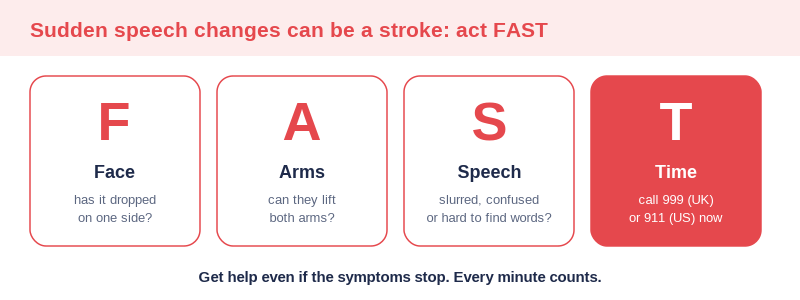
Symptoms can stop after a short time, and the NHS says to get medical help straight away even then, and not to drive yourself to A&E. The NHLBI also advises calling an ambulance rather than driving, so treatment can begin on the way. In one reported hospital case, sudden stuttering that went away within about two hours turned out to be a small stroke.1,10,4
How a stroke can affect speech and language
Communication problems are very common after a stroke: the Stroke Association says around two-thirds of people have them directly afterwards, and some people have long-term difficulties. The impact is different for each person, depending on the size of the stroke and where it happened in the brain.11
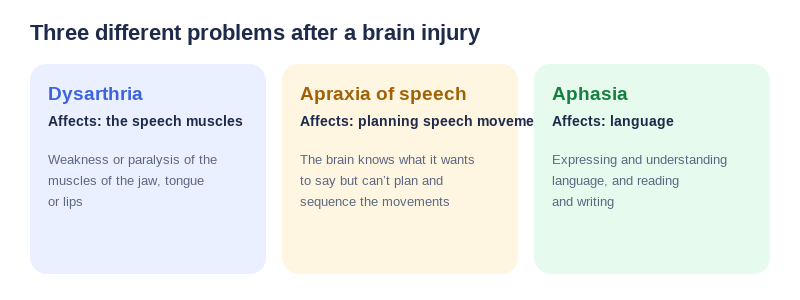
| Condition | What it affects | After a stroke |
|---|---|---|
| Dysarthria | The muscles of the face, mouth and voice box, which can be weak; speech may be slurred, slow, quiet or strained | About one in four people have it directly after a stroke, and another one in four have it together with aphasia |
| Apraxia of speech | Planning and sequencing speech movements; it isn’t caused by weakness of the speech muscles | Less common than aphasia and dysarthria, and can occur with both |
| Aphasia | Expressing and understanding language, and reading and writing; it has nothing to do with intelligence | About a third of people have it after a stroke |
Three conditions that can follow a stroke, as the NIDCD and the Stroke Association describe them.12,7,6
As the diagram shows, these are different problems, and they can happen together: the NIDCD says aphasia may co-occur with dysarthria or apraxia of speech. The Stroke Association notes it can be tricky to tell apraxia of speech apart from other communication problems, and that a speech-language pathologist (SLP), called a speech and language therapist in the UK, can help with a diagnosis.6,12
Speech therapy after a stroke
In the UK, NICE recommends screening people for communication difficulties within 72 hours of stroke symptoms starting, and referring anyone with suspected difficulties to an SLP for detailed assessment. The SLP then provides individualised therapy for specific problems such as aphasia or dysarthria.15
The Stroke Association calls speech and language therapy the main treatment for communication problems. For dysarthria that limits communication, the stroke guideline for the UK and Ireland says people should be trained in techniques to make their speech clearer, and assessed for aids such as a letter board if speech remains hard to understand.13,16
A Cochrane review of dysarthria after stroke and brain injury found five small trials with 234 people in total and no definitive trials, but concluded that people should keep receiving rehabilitation according to clinical guidelines. The UK and Ireland guideline likewise notes little evidence for the interventions in common use, but some evidence of qualitative benefits.17,16
When to see an SLP
If you or someone close to you has speech or language changes after a stroke, ask the stroke team about a referral to an SLP. If problems are still there at a later stroke review, ask to be referred back. Any new or sudden change is an emergency first. Our find-support page explains how to look for an SLP through your country’s register.
Recovery: what guidance says
The NHS says some people recover within days or weeks with little impact on their life, while for others recovery takes months or years. The Stroke Association says the fastest recovery usually happens in the first weeks and months, but there is no set time limit and it can continue at a slower pace for years.9,13
For aphasia, the NIDCD says people can often experience dramatic improvements in the first few months, even without treatment, though in many cases some aphasia remains, and that language and communication can continue to improve for many years. The NHS says people can still improve months or years later, and some recover fully.6,8
The Stroke Association says communication can have good days and bad days, and tiredness, low mood or a busy, noisy place can make it harder. The NHS says you should get a review of your progress after about 6 months, and to speak to your team if you don’t; NICE says persisting difficulties found at the 6-month or annual review should lead to a referral back to an SLP.11,9,15
Practice at home
The Stroke Association says speech and language therapy isn’t just the time spent with the therapist, and progress only comes with practice. It adds that apps and computer programmes for speech and language exercises work best with some guidance from an SLP, and NICE suggests a computer-based programme for word finding alongside face-to-face therapy.13,15
In research on dysarthria, cues to speak louder or more slowly didn’t give every speaker an intelligibility benefit, and ASHA says choosing the right strategies depends on the cause, the type of dysarthria and which parts of speech are affected.18,5
So what to practise is for your SLP to decide. If your SLP suggests work on pace, pauses or phrasing, SpeechStep’s free speaking rate test gives you a starting point to compare against later. You read a short passage aloud, then talk freely for 30 seconds, and see each part’s rate side by side. It’s analysed on your device, the result is indicative, not a diagnosis, and it doesn’t identify dysarthria or any other condition, so compare it only with your own earlier results.
Free Speaking Rate Test
Read a short passage aloud, then talk freely for 30 seconds. Analysed on your device; indicative, not a diagnosis.
SpeechStep Pacing offers steady reading, phrase pacing and pause practice for adults, with a re-test on a matched passage so changes are comparable. After a stroke, use it only with your SLP’s advice and within their plan, with any target set by them. The aim is controlled speech, not slower speech.
Help for families and carers
NICE recommends training in communication skills, such as slowing down, not interrupting and using props, gestures or drawing, for people who regularly talk with someone who has aphasia after stroke, and it advises limiting background noise. The UK and Ireland guideline says communication partners of someone with severe dysarthria should be trained in how to help.15,16
The Stroke Association suggests going to therapy sessions if you can, or asking the therapist for training as a communication partner. It also suggests choosing a moment when the person has enough energy, since fatigue can be worse in the afternoon, and notes that a one-to-one conversation is easier than a group chat.14
- Give time and attention, and allow silences.
- Try not to interrupt.
- Ask questions, give feedback and check you’ve understood.
- Turn the TV down or move somewhere quieter before you talk.
What SpeechStep can and can’t do
SpeechStep offers practice, not therapy. Its tools look at pace and pauses, not loudness or voice quality, and they don’t assess, identify or treat stroke, dysarthria, apraxia of speech or aphasia. The speaking rate test is indicative and analysed on your device. If you opt in to human review, an authorised SpeechStep reviewer may listen to eligible recordings and give personal feedback, but it isn’t clinical guidance. For assessment and therapy, see an SLP.
Frequently asked questions
How long does it take to regain speech after a stroke?+
There’s no set timeline. The Stroke Association says the fastest recovery usually happens in the first weeks and months, but there’s no set time limit and progress can continue more slowly for years. The NHS says some people recover in days or weeks, while for others it takes months or years.
What speech problems can happen after a stroke?+
Around two-thirds of people have communication problems directly after a stroke, according to the Stroke Association. These include dysarthria (weak speech muscles), apraxia of speech (difficulty planning speech movements) and aphasia (difficulty using or processing language, which has nothing to do with intelligence). The NIDCD says aphasia may co-occur with dysarthria or apraxia of speech, and the Stroke Association says a speech and language therapist can help with a diagnosis when it’s tricky to tell apraxia of speech apart from other problems.
Does speech therapy help after a stroke?+
The Stroke Association calls speech and language therapy the main treatment for communication problems, and NICE recommends individualised therapy for problems such as aphasia or dysarthria. For dysarthria, a Cochrane review found only five small trials and no definitive ones, but concluded that people should keep receiving rehabilitation according to clinical guidelines.
What should I do if someone’s speech suddenly becomes slurred?+
Treat it as a possible stroke and call your local emergency number at once: the NHS says call 999, and MedlinePlus says call 911 in the US. Get help even if the symptoms stop.
How can I help a family member with talking after a stroke?+
Ask their SLP about training as a communication partner, which NICE and the Stroke Association both recommend. Pick a time when they have energy, give time and attention, try not to interrupt, allow silences and check you’ve understood.
Can an app help with speech after a stroke?+
The Stroke Association says apps and computer programmes for speech and language exercises work best with some guidance from a therapist, and NICE suggests computer-based word-finding practice alongside face-to-face therapy. SpeechStep is practice, not therapy, so use it only with your SLP’s advice.
Practise your own speech, one sound at a time
Free with an account: your first practice day is a full session of 14 words, then 5 words a day, with AI feedback on the sounds it supports. SpeechStep is practice, not therapy, and it doesn’t diagnose.
Need a licensed professional? Where to find a speech-language pathologist
References
18 sources from authoritative bodies. Last reviewed November 2026.
- 1.NHS (nhs.uk)Symptoms of a stroke — Health A to Z page, 2024.
- 2.NHS (nhs.uk)Dysarthria (difficulty speaking) — Health A to Z page, 2023.
- 3.MedlinePlus, U.S. National Library of MedicineStroke — Health topic page, 2025.
- 4.CureusSalter et al. Transient Stuttering as a Sole Presentation in a Patient With a Subcentimeter Left Frontal Cortical Ischemic Infarct — Case report (open access, CC BY), 2024.
- 5.ASHADysarthria in Adults (Practice Portal) — Practice Portal page.
- 6.NIDCDAphasia (last updated 16 April 2025) — Patient information page, 2025.
- 7.NIDCDApraxia of Speech (last updated 31 October 2017) — Patient information page, 2017.
- 8.NHS (nhs.uk)Aphasia (last reviewed 1 April 2025) — Patient information page, 2025.
- 9.NHS (nhs.uk)Recovering from a stroke (last reviewed 12 September 2024) — Patient information page, 2024.
- 10.National Heart, Lung, and Blood Institute (NIH)Stroke - Symptoms (last updated 26 May 2023) — Patient information page, 2023.
- 11.Stroke Association (UK charity)Communication problems (after stroke) — Patient information page, 2023.
- 12.Stroke Association (UK charity)Types of communication problems (aphasia, dysarthria, apraxia of speech) — Patient information page, 2025.
- 13.Stroke Association (UK charity)Communication treatment and tools — Patient information page, 2025.
- 14.Stroke Association (UK charity)Tips for aiding communication — Patient information page, 2025.
- 15.National Institute for Health and Care Excellence (NICE)Stroke rehabilitation in adults (NG236): Recommendations — Guideline, 2023.
- 16.Intercollegiate Stroke Working Party, National Clinical Guideline for Stroke for the UK and Ireland (copy hosted by Western Health and Social Care Trust, Northern Ireland)National Clinical Guideline for Stroke for the UK and Ireland, 2023 edition (sections 4.43 Aphasia, 4.44 Dysarthria) — Guideline, 2023.
- 17.Cochrane Database of Systematic Reviews (abstract and plain language summary via PMC)Interventions for dysarthria due to stroke and other adult-acquired, non-progressive brain injury (Mitchell, Bowen, Tyson, Butterfint, Conroy) — Systematic review, 2017.
- 18.Journal of Speech, Language, and Hearing Research (abstract via PMC)Predicting Intelligibility Gains in Individuals With Dysarthria From Baseline Speech Features (Fletcher, McAuliffe, Lansford, Sinex, Liss) — Journal article (abstract), 2017.
Keep reading
Dysarthria in Adults
What dysarthria is, its causes, and how an SLP helps.
Read →Dysarthria vs Aphasia
How speech, language and planning problems differ.
Read →Slurred Speech
When slurred speech is an emergency, and what else can cause it.
Read →Dysarthria Exercises
What practice with an SLP may involve.
Read →