Dysarthria vs Aphasia: What’s the Difference?
Dysarthria is a motor speech disorder: slow, weak or uncoordinated speech movements can make speech slurred or hard to understand. Aphasia is a language disorder affecting speaking, understanding, reading and writing. They may occur together. Sudden speech changes need emergency help.
The short answer
If speech changes suddenly
Speech that suddenly becomes slurred or garbled, or new difficulty speaking, especially with a face drooping on one side or weakness in an arm, can be a sign of a stroke. Call your local emergency number straight away (999 in the UK, 911 in the US). Don’t wait to see whether it passes.
The NHS lists a face that droops on one side, being unable to lift both arms and keep them there, and difficulty speaking, with speech that may be slurred or garbled, as signs of a stroke, which is a medical emergency. Stroke symptoms can stop after a short time, and the NHS says to get medical help straight away even if they do. ASHA advises seeing a doctor right away for any new difficulty talking.2,1,4
Dysarthria is a problem with the movements of speech: they become slow, weak, imprecise or uncoordinated, which affects how well speech can be understood. Aphasia is a problem with language, affecting the expression and understanding of language, as well as reading and writing. Apraxia of speech is different again: it is not caused by weakness of the speech muscles, but the brain cannot properly plan and sequence the movements for speech. Aphasia may co-occur with dysarthria or apraxia of speech.12,3,6,7
Dysarthria: a motor speech disorder
ASHA describes dysarthria as a group of neurogenic speech disorders marked by abnormalities in the strength, speed, range, steadiness, tone or accuracy of the movements used for breathing, voice, resonance, articulation and prosody. Its public page puts it more simply: brain or nerve damage changes the way your muscles work, which can make speech sound slow, slurred or hard to understand.3,4
ASHA lists signs such as slurring or mumbling, talking too slowly or too fast, talking too quietly or too loudly, and people having trouble understanding your words. After a stroke, the Stroke Association also describes a quiet or strained voice, a voice that doesn’t change its tone, and hesitating a lot or speaking in short bursts rather than full sentences.4,9
ASHA says anything that damages the brain or nerves can lead to dysarthria, including stroke, brain injury, Parkinson’s disease, multiple sclerosis, ALS, cerebral palsy and tumours. It estimates that dysarthria affects approximately 44%–88% of people with Parkinson’s disease, and that 22%–58% of people with acute stroke present with it.4,3
ASHA says dysarthria affects only speech production. A Cochrane review notes that people with dysarthria do not have difficulties thinking, remembering or retrieving words, yet dysarthria can cause people to lose confidence when talking and become socially isolated, even if others see the symptoms as mild.3,13
Aphasia: a language disorder
ASHA describes aphasia as an acquired neurogenic language disorder resulting from an injury to the brain, typically the left hemisphere. It lists four primary areas it can affect: spoken expression, written expression, understanding spoken language and reading. The NHS notes it is also called dysphasia.5,8
The Stroke Association explains that aphasia means problems with using or processing language, and stresses that it has nothing to do with intelligence, memory or thinking skills.9
The NIDCD says stroke is the leading cause, and cites the National Aphasia Association’s estimates that about one third of stroke survivors have aphasia and that about 2 million people in the United States are living with it. People with aphasia can often experience dramatic improvements in the first few months, even without treatment, but in many cases some aphasia remains, and language and communication abilities can continue to improve for many years after the brain injury.6
Apraxia of speech
Apraxia of speech (AOS) affects the brain pathways involved in planning the sequence of movements for speech. In the NIDCD’s words, the brain knows what it wants to say but cannot properly plan and sequence the required movements. It is not caused by weakness or paralysis of the jaw, tongue or lip muscles; weakness or paralysis of the speech muscles results in dysarthria.7
Acquired AOS may result from a stroke, head injury, tumour or other illness affecting the brain. For example, someone with AOS may say a difficult word correctly but then have trouble repeating it, or be able to say a sound one day and have trouble with the same sound the next.7
The Stroke Association says apraxia of speech is less common than aphasia and dysarthria and can occur with both. It adds that it can be tricky to tell apart from other communication problems, and that a speech and language therapist can help with a diagnosis.9
Side by side
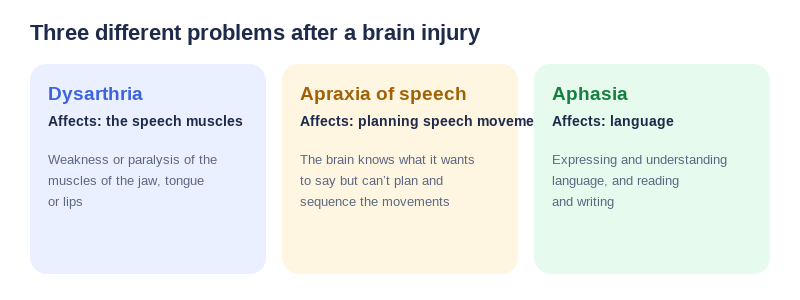
As the diagram shows, the NIDCD links dysarthria to weakness or paralysis of the speech muscles, apraxia of speech to difficulty planning and sequencing speech movements, and aphasia to the expression and understanding of language, as well as reading and writing. The NIDCD also says aphasia may co-occur with speech disorders such as dysarthria or apraxia of speech. The Stroke Association reports that about one in four people have dysarthria directly after a stroke, and another one in four have dysarthria together with aphasia.7,6,9
| Feature | Dysarthria | Apraxia of speech | Aphasia |
|---|---|---|---|
| Type | Motor speech impairment | Disorder of planning speech movements | Language disorder |
| What’s affected | Strength, speed, range, steadiness, tone or accuracy of speech movements | Planning and sequencing the movements; the brain knows what it wants to say | Expressing and understanding language, including reading and writing |
| How it can show | Slow, slurred or hard-to-understand speech | A word said correctly once may be hard to repeat | Difficulty speaking, reading, writing and understanding others |
| Muscle weakness | Weakness or paralysis of the speech muscles results in dysarthria | No, unless dysarthria is also present | Affects language comprehension and expression; may co-occur with dysarthria |
| Common causes | Stroke, brain injury, Parkinson’s, MS, ALS and others | Stroke, head injury, tumour or other brain illness | Usually stroke or traumatic brain injury |
Dysarthria, apraxia of speech and aphasia compared, as ASHA, the NIDCD, the NHS and the UK stroke guideline describe them.12,3,4,7,6,8
How they are assessed and treated
After a stroke, NICE recommends screening people for communication difficulties within 72 hours of onset of stroke symptoms, and referring people with suspected communication difficulties to a speech and language therapist for detailed analysis and assessment. ASHA notes that choosing treatment strategies for dysarthria depends on the cause, the type of dysarthria and the parts of speech production affected.11,3
NICE calls for individualised therapy for specific communication impairments such as aphasia or dysarthria. For dysarthria, ASHA says work with an SLP depends on the type of dysarthria and may include slowing down your speech, talking louder, moving your lips and tongue more and saying sounds clearly in words and sentences. For aphasia, the NHS says therapy usually involves the people around you, like family or friends, and the NIDCD describes communication partner training as an essential element of a strong therapy programme.11,4,8,6
A 2017 Cochrane review of interventions for dysarthria after stroke and other non-progressive brain injury included five small trials with 234 participants in total, and found no definitive, adequately powered trials. It advised that people with dysarthria after stroke or brain injury continue to receive rehabilitation according to clinical guidelines.13
When to see an SLP
See a doctor right away for any new difficulty talking, and call your local emergency number if it comes on suddenly. If you’ve noticed gradual changes in your speech and you’re worried, the NHS suggests seeing a GP. A speech-language pathologist (SLP) can assess what is happening and plan therapy with you; our find-support page explains how to find one through your country’s register.
Where practice fits
The Stroke Association says speech and language therapy isn’t just about the time spent with the therapist and that improvements only come with practice, and that apps and computer programmes for speech and language exercises work best with some guidance from a speech and language therapist. In a study of 50 speakers (43 with dysarthria and 7 older individuals) reading a standard passage, cues to speak louder and reduce rate did not confer intelligibility benefits to every speaker.10,14
So the strategy, and any target, comes from your SLP. If your SLP suggests work on pace, pauses or phrasing, SpeechStep Pacing offers steady reading at a steady guide pace, phrase pacing and pause practice. The aim is controlled speech, not slower speech.
Free Speaking Rate Test
Read a short passage aloud, then talk freely for 30 seconds. Analysed on your device; indicative, not a diagnosis.
What SpeechStep can and can’t do
The free speaking rate test shows your rate in syllables per second while you read aloud and talk freely. It’s analysed on your device, and results are indicative, not a diagnosis. It doesn’t identify dysarthria, aphasia, apraxia of speech or any other condition, SpeechStep doesn’t measure loudness or voice quality, and it is practice, not therapy. Compare results with your own earlier results, and use any practice within your SLP’s plan.
Frequently asked questions
What is the difference between dysarthria and aphasia?+
Dysarthria affects speech production: ASHA describes abnormalities in the strength, speed or accuracy of the movements used for speech. Aphasia affects language: understanding and expressing language, including reading and writing. People with dysarthria do not have difficulties thinking, remembering or retrieving words.
Can you have dysarthria and aphasia at the same time?+
Yes. The NIDCD says aphasia may co-occur with dysarthria or apraxia of speech. The Stroke Association reports that about one in four people have dysarthria directly after a stroke, and another one in four have dysarthria together with aphasia.
What is the difference between apraxia and dysarthria?+
Apraxia of speech is a problem with planning and sequencing speech movements: the brain knows what it wants to say but can’t properly plan the movements. Weakness or paralysis of the speech muscles results in dysarthria. The Stroke Association says apraxia of speech can occur with dysarthria, can be tricky to tell apart from other communication problems, and that a speech and language therapist can help with a diagnosis.
Does aphasia affect intelligence?+
No. The Stroke Association says aphasia means problems with using or processing language, and has nothing to do with intelligence, memory or thinking skills.
Is slurred speech dysarthria or aphasia?+
ASHA describes slurred speech as one way dysarthria can sound. But slurred or garbled speech that comes on suddenly can be a sign of a stroke, so call your local emergency number straight away. For any new difficulty talking, ASHA advises seeing a doctor right away.
Can a speaking rate test tell me if I have dysarthria?+
No. SpeechStep’s speaking rate test is indicative, analysed on your device and not a diagnosis, and it doesn’t identify dysarthria, aphasia or any other condition. If you’re worried about your speech, see a doctor or an SLP.
Practise your own speech, one sound at a time
Free with an account: your first practice day is a full session of 14 words, then 5 words a day, with AI feedback on the sounds it supports. SpeechStep is practice, not therapy, and it doesn’t diagnose.
Need a licensed professional? Where to find a speech-language pathologist
References
14 sources from authoritative bodies. Last reviewed November 2026.
- 1.NHS (nhs.uk)Symptoms of a stroke — Health A to Z page, 2024.
- 2.NHS (nhs.uk)Dysarthria (difficulty speaking) — Health A to Z page, 2023.
- 3.ASHADysarthria in Adults (Practice Portal) — Practice Portal page.
- 4.ASHADysarthria (public information page; last reviewed 1 May 2026) — Patient information page, 2026.
- 5.ASHAAphasia (Practice Portal) — Practice Portal page.
- 6.NIDCDAphasia (last updated 16 April 2025) — Patient information page, 2025.
- 7.NIDCDApraxia of Speech (last updated 31 October 2017) — Patient information page, 2017.
- 8.NHS (nhs.uk)Aphasia (last reviewed 1 April 2025) — Patient information page, 2025.
- 9.Stroke Association (UK charity)Types of communication problems (aphasia, dysarthria, apraxia of speech) — Patient information page, 2025.
- 10.Stroke Association (UK charity)Communication treatment and tools — Patient information page, 2025.
- 11.National Institute for Health and Care Excellence (NICE)Stroke rehabilitation in adults (NG236): Recommendations — Guideline, 2023.
- 12.Intercollegiate Stroke Working Party, National Clinical Guideline for Stroke for the UK and Ireland (copy hosted by Western Health and Social Care Trust, Northern Ireland)National Clinical Guideline for Stroke for the UK and Ireland, 2023 edition (sections 4.43 Aphasia, 4.44 Dysarthria) — Guideline, 2023.
- 13.Cochrane Database of Systematic Reviews (abstract and plain language summary via PMC)Interventions for dysarthria due to stroke and other adult-acquired, non-progressive brain injury (Mitchell, Bowen, Tyson, Butterfint, Conroy) — Systematic review, 2017.
- 14.Journal of Speech, Language, and Hearing Research (abstract via PMC)Predicting Intelligibility Gains in Individuals With Dysarthria From Baseline Speech Features (Fletcher, McAuliffe, Lansford, Sinex, Liss) — Journal article (abstract), 2017.
Keep reading
Dysarthria in Adults
What dysarthria is, its causes and how an SLP helps.
Read →Speech After a Stroke
Communication changes after a stroke and what recovery involves.
Read →Slurred Speech
When slurred speech is an emergency, and what can cause it.
Read →Dysarthria Exercises
What practice with an SLP may cover, and how to support it at home.
Read →