Cluttering vs Stuttering: What’s the Difference?
Stuttering interrupts speech with repeated sounds, stretched sounds and blocks; cluttering makes speech sound rapid, irregular or hard to follow. They are different fluency disorders that can happen together, and measured speed alone can’t tell them apart. An SLP assesses which is which.
The short answer
Stuttering is an interruption in the flow of speaking caused by disfluencies, and it is the most common fluency disorder. Cluttering is also a fluency disorder, but it involves speech that sounds rapid, unclear and/or disorganised.6,4
Is cluttering a form of stuttering? No. The Stuttering Foundation says the two are not the same disorder, and the International Cluttering Association describes them as closely related. ASHA notes that they can co-occur, but there are important distinctions between them.4,15,6
In cluttering, the measured speech rate is not always greater than average, even though the listener perceives it as rapid. A 2024 study by Tomisato and colleagues notes there is no established method to clearly differentiate the two disorders.1,20
What cluttering is
ASHA, citing St. Louis and Schulte (2011), lists the characteristic signs of cluttering as a speech rate “perceived to be abnormally rapid and/or irregular”, an excessive number of non-stuttering-like disfluencies, frequent irregular patterns of pausing, and/or frequent over-coarticulated speech.1
That can mean leaving off word endings or collapsing syllables: ASHA gives examples such as “Turn the televisoff” and “I wanwatevision”. Words can sound as if they are running into each other, and people who clutter may use lots of filler words such as “like” and “um”, pause in unusual places, or have some difficulty sticking to the topic.1,15,14
Many people who clutter are unaware of their difficulties, which is one reason many are not diagnosed until adulthood, though many are aware that others have difficulty understanding them. ASHA says cluttering is often diagnosed at about 8 years old, when a child’s language becomes lengthy or complex enough for symptoms to be noticeable.15,6,1
What stuttering is
Stuttering, which most people in the UK, Ireland and India call stammering, is a speech disorder marked by repetitions of sounds, syllables or words, prolonged sounds, and interruptions known as blocks. The Stuttering Foundation gives examples such as repetitions (“li-li-like this”) and prolongations (“lllllike this”).12,8,10
A person who stutters typically knows exactly what they want to say but is temporarily unable to say it. Stuttering may also include tension and negative feelings about talking, and some people may try to hide it because they worry about what others may think.4,7
Most stuttering starts in early childhood, between the ages of 2 and 5, though it can sometimes start in adults. The RCSLT says it is not caused by anxiety, although stressful environments can put an increased demand on speech.12,13
Key differences side by side
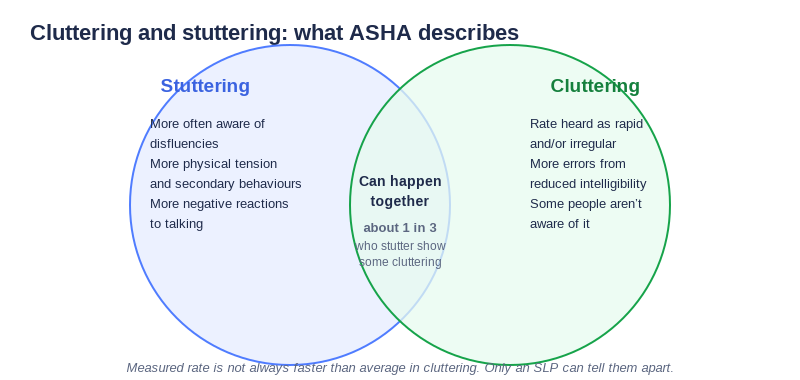
Read the table and diagram below as tendencies, not a checklist for your own speech.
Stuttering-like symptoms can also occur in cluttering, so people whose main concern is speech disfluency may have a mixture of stuttering and cluttering.20
| Feature | Stuttering | Cluttering |
|---|---|---|
| Main pattern | Repetitions of sounds, syllables or words, prolonged sounds and blocks | Speech that sounds rapid, unclear and/or disorganised |
| Type of disfluency | Part-word repetitions, prolongations and blocks | Lots of “um”, “uh”, revised phrases and repeated words, without struggle or muscle tension |
| Knowing what to say | Knows what they intend to say but is held up at the motor level | May not know all of what they want to say, or how, but carries on talking |
| Awareness | More likely to be self-aware about disfluencies | Some aren’t aware; many know others have trouble understanding them |
| Tension and clarity | More physical tension, secondary behaviours and negative reactions to talking | More errors from reduced intelligibility linked to rapid rate |
| When speech may go better | Singing, reading or speaking in unison may temporarily reduce stuttering | Often at its best when actively monitoring speech, such as when being recorded |
How ASHA, the Stuttering Foundation, NIDCD and the International Cluttering Association describe the two. Tendencies, not a checklist.8,4,16,15,6,3
When both happen together
Stuttering and cluttering can co-occur. Experts have consistently estimated that about one third of children and adults who stutter also show at least some components of cluttering, though ASHA notes there are more clinical anecdotes than data behind that figure.6,1
Other estimates vary widely. The 2024 textbook by van Zaalen and Reichel reports that 13 to 43 percent of people who clutter in clinical settings show symptoms of both, and a 2026 study by Tomisato and colleagues cites research putting the share of people diagnosed with speech disfluency who also show cluttering symptoms at between 12 and 43%.18,19
Cluttering sometimes does not emerge as a clear condition until stuttering has eased, and some adults who clutter may first have been diagnosed with stuttering. The RCSLT says cluttering on its own is quite rare and typically appears alongside other differences such as stuttering, dyslexia, dyspraxia, ADHD, developmental language disorder or autism, while the International Cluttering Association notes that people diagnosed with ADHD do not necessarily clutter.16,6,14
Why speed alone can’t tell them apart
ASHA says the measured speech rate of someone who clutters is not always greater than average, but the listener perceives it as rapid. The Stuttering Foundation says that even when the speaker may not be speaking faster than average, they are speaking “at a rate that is too fast for their system to handle”. Van Zaalen and Reichel put the primary concern not on the number of syllables per second but on whether speakers are able to adjust their speaking rate.1,4,18
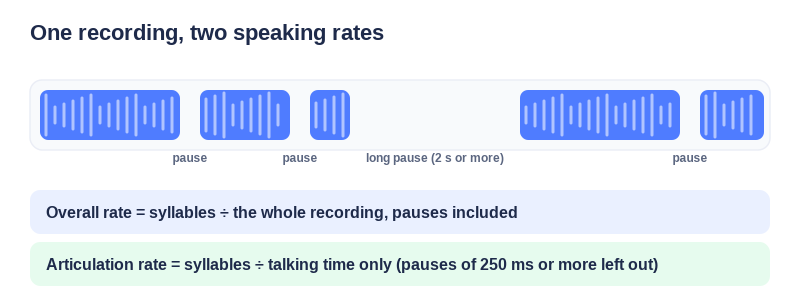
The same authors say not every speaker with a fast speech rate should be diagnosed with cluttering, and they list tachylalia, a fast speech rate, as “not a disorder”. In a study of school-age children by Logan and colleagues, overall speech rate (based on fluent and disfluent utterances) was slower in children who stutter, and disfluency frequency predicted speech rate better than age or utterance length, while articulation rate (based on fluent utterances only) did not differ significantly.17,5
Free Speaking Rate Test
Read a short passage aloud, then talk freely for 30 seconds. Analysed on your device; indicative, not a diagnosis.
What SpeechStep can and can’t do
SpeechStep’s free speaking rate test shows your rate in syllables per second for reading aloud and for talking freely, side by side. As the diagram shows, “View details” separates overall rate, which includes pauses, from articulation rate, which leaves out pauses of 250 ms or more, and counts long pauses of 2 seconds or more. It’s analysed on your device, the free-speech number is approximate, and results are indicative, not a diagnosis: the test doesn’t identify stuttering, cluttering or any other condition, and it’s best compared with your own earlier results. SpeechStep Pacing offers steady reading, phrase pacing and pause practice that you can use alongside an SLP’s plan. The aim is controlled speech, not slower speech.
Getting an assessment
A fluency evaluation is more accurate when it includes self-report and samples of speech across various situations and tasks, such as recordings made outside the clinic. The International Cluttering Association says a definitive diagnosis of cluttering can only be made by a speech-language pathologist (SLP) with experience and expertise in it, and that an SLP with expertise in fluency disorders is often the ideal professional to see.1,15
An SLP may ask you to increase pausing or decrease your speech rate to see what changes; ASHA notes that a reduction of overall rate typically helps reduce cluttering symptoms, but a dramatic improvement is not definitive, because similar changes may occur with stuttering. In the UK, adults can ask a GP for a referral, self-refer to the local speech and language therapy service, or contact a private therapist; ASHA’s ProFind directory lists certified SLPs.1,13,2
Stuttering that appears suddenly in an adult is different. The Stuttering Foundation says that in the vast majority of cases the sudden appearance of disfluent speech in an adult should be considered abnormal. The NHS lists a face drooping on one side, being unable to lift both arms and keep them there, and difficulty speaking, where speech may be slurred or garbled, as possible signs of a stroke, which is a medical emergency, and says to call 999.11,9
When to see an SLP
If your speech or someone else’s changes suddenly, including slurred or garbled speech or new stuttering, call your local emergency number straight away, because it can be a stroke. Otherwise, talk to an SLP if people often find your speech hard to follow or ask you to repeat yourself, if you get stuck, repeat sounds or tense up when you talk, or if worry about speaking is holding you back at work or socially. You don’t need to know whether it’s cluttering or stuttering first; working that out is part of the assessment. If you’d like to practise pacing, do it with your SLP’s advice and let them set any target. The find-support page explains how to find an SLP through your country’s register.
Frequently asked questions
What is the difference between stuttering and cluttering?+
Stuttering interrupts speech with repeated sounds, syllables or words, prolonged sounds and blocks; the person typically knows what they want to say but is temporarily unable to say it. Cluttering makes speech sound rapid, unclear or disorganised, and the speaker may not know all of what they want to say but keeps talking. An experienced SLP assesses which is present.
Is cluttering a form of stuttering?+
No. Both are fluency disorders, but the Stuttering Foundation says they are not the same, and recent research describes cluttering as distinct from stuttering. They are closely related and can occur together.
Can you have both stuttering and cluttering?+
Yes. Experts have estimated that about one third of children and adults who stutter also show at least some components of cluttering. ASHA notes that this estimate rests more on clinical anecdotes than on data.
What are examples of cluttering vs stuttering?+
ASHA’s examples of cluttering include omitted word endings and collapsed syllables, such as “Turn the televisoff” or “I wanwatevision”. The Stuttering Foundation’s examples of stuttering include repetitions (“li-li-like this”) and prolongations (“lllllike this”). Examples help explain the terms, but they are not a way to label your own speech.
Is cluttering just talking fast?+
No. ASHA says the measured rate of someone who clutters is not always greater than average, even though listeners perceive it as rapid. Van Zaalen and Reichel also say that not every speaker with a fast speech rate should be diagnosed with cluttering.
Can a speaking rate test tell me if I clutter or stutter?+
No. In cluttering the measured rate is not always greater than average, and a definitive diagnosis comes from an experienced SLP. SpeechStep’s speaking rate test is analysed on your device and is indicative, not a diagnosis; it doesn’t identify stuttering, cluttering or any other condition.
Practise your own speech, one sound at a time
Free with an account: your first practice day is a full session of 14 words, then 5 words a day, with AI feedback on the sounds it supports. SpeechStep is practice, not therapy, and it doesn’t diagnose.
Need a licensed professional? Where to find a speech-language pathologist
References
20 sources from authoritative bodies. Last reviewed November 2026.
- 1.ASHAStuttering, Cluttering, and Fluency — Practice Portal page.
- 2.ASHAFind Certified Audiologists and Speech-Language Pathologists (SLPs) — Directory of certified professionals.
- 3.NIDCDWhat Is Stuttering? Diagnosis & Treatment — Health information page.
- 4.Stuttering FoundationCluttering — Brochure (written by fluency researchers).
- 5.Journal of Communication Disorders (author-hosted full text, UT Austin)Logan K.J., Byrd C.T., Mazzocchi E.M. & Gillam R.B. Speaking rate characteristics of elementary-school-aged children who do and do not stutter — Journal article, 2011.
- 6.ASHAStuttering, Cluttering, and Fluency (definitions, prevalence, cluttering vs stuttering, adults) — Practice Portal page.
- 7.ASHAStuttering and Cluttering — Consumer page.
- 8.NIDCDStuttering — Health information page, 2017.
- 9.NHS (nhs.uk)Dysarthria (difficulty speaking) — Health A to Z page, 2023.
- 10.Stuttering Foundation of AmericaFAQ — FAQ page.
- 11.Stuttering Foundation of AmericaNeurogenic Stuttering — Brochure page.
- 12.STAMMA (British Stammering Association)What Is Stammering? — Information page.
- 13.Royal College of Speech and Language Therapists (RCSLT)Stammering overview — Public clinical information page, 2025.
- 14.Royal College of Speech and Language Therapists (RCSLT)Cluttering overview — Public clinical information page.
- 15.International Cluttering Association (compiled by K. Scaler Scott, F. Myers, P. Kissagizlis)What is Cluttering? — Information page.
- 16.International Cluttering Association, Clinical Issues Committee (van Zaalen, Myers, Ward, Bennett)Cluttering Assessment — Clinical guideline page.
- 17.Routledge (TalkBank copy)van Zaalen, Y. & Reichel, I. An Introduction to Cluttering (Section 5.2.1 Cluttering and tachylalia; Sections 2.2.7, 4.5.1) — Book, 2024.
- 18.Routledge (TalkBank copy)van Zaalen, Y. & Reichel, I. An Introduction to Cluttering (theory and assessment chapters) — Book, 2024.
- 19.Frontiers in PsychologyTomisato S. et al. Social anxiety and life impact in adults who clutter and stutter: a comparative study with pure stuttering — Journal article (open access, CC BY), 2026.
- 20.Frontiers in PsychologyTomisato S. et al. Speech characteristics that differentiate stuttering and cluttering in Japanese speakers — Journal article (open access, CC BY), 2024.
Keep reading
What Is Cluttering?
An overview of cluttering and how it affects clear communication.
Read →Cluttering Symptoms
The signs sources describe, from irregular rate to running-together words.
Read →Stuttering in Adults
How stuttering affects adults, and where to find support.
Read →Tachylalia
Fast speech on its own, and why it isn’t the same as cluttering.
Read →