Tachylalia: What “Very Fast Speech” Means
Tachylalia means a fast speech rate without neurological symptoms or a psychological cause, with pauses still in sensible places. It isn’t cluttering, and one clinical text lists it as not a disorder. Speed alone can’t tell the two apart; a speech-language pathologist can.
What tachylalia means
Tachylalia is a term for fast speech. In their 2024 clinical book on cluttering, van Zaalen and Reichel describe it as a fast speech rate without neurological symptoms or a psychological cause.13
As the book describes it, people with tachylalia always speak at a fast rate. Their pauses are shorter but fall in linguistically appropriate places, and a summary figure in the book lists tachylalia as a fast speech rate that is “not a disorder”.13
The word also turns up in clinical assessment: the International Cluttering Association lists a family history of speech or language disorders, including fluency disorders and tachylalia, among the things a cluttering assessment looks at.12
If you came here searching for “abnormally fast speech” or a “fast speech disorder”, one point from the clinical literature is worth knowing. Van Zaalen and Reichel note that not every speaker with impaired speech intelligibility or a fast speech rate should be diagnosed with cluttering.13
Tachylalia and cluttering
The Stuttering Foundation describes cluttering as a fluency disorder. ASHA, citing St. Louis and Schulte (2011), describes its characteristic signs as a speech rate “perceived to be abnormally rapid and/or irregular”, an excessive number of nonstuttering-like disfluencies, frequent irregular patterns of pausing and/or frequent over-coarticulated speech.2,1
Van Zaalen and Reichel draw the line with tachylalia like this: people who clutter often speak at a fast and variable rate, with short pauses in linguistically wrong places, while people with tachylalia always speak at a fast rate, with shorter pauses in linguistically appropriate places. The same book mentions online videos of people who speak 100 percent accurately even at an articulatory rate of more than ten syllables per second.13
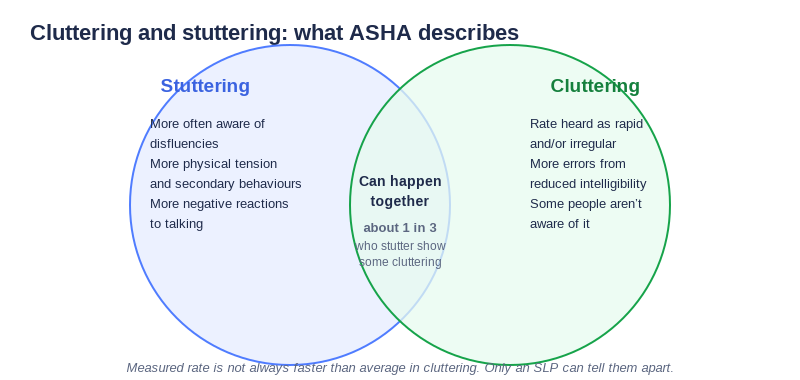
The diagram shows distinctions ASHA draws between cluttering and stuttering. ASHA says the two can co-occur, that people who stutter are more likely to be self-aware about their disfluencies, and that people who clutter may show more errors related to reduced intelligibility due to rapid rate. Experts have estimated that about one third of people who stutter show at least some components of cluttering, though ASHA notes there are more clinical anecdotes than data behind this.9,1
Why rate alone isn’t a diagnosis
ASHA notes that in cluttering the speaker’s measured rate is not always greater than average, even though the listener perceives it as rapid. The Stuttering Foundation puts it similarly: the speaker may not be speaking faster than average, yet is speaking at a rate too fast for their system to handle, resulting in communication breakdown.1,2
Van Zaalen and Reichel make the same point from the other side: the main concern with an excessively fast or irregular rate is not the number of syllables per second but whether the speaker can adjust their rate. In one case example, they say more than a fast rate is needed to diagnose a boy with cluttering, and that if all three core characteristics are absent, he presents with tachylalia.14,13
A 2026 review of cluttering in children and adolescents describes it as a developmental vulnerability in motor–cognitive integration rather than a purely rate-based fluency disturbance. A 2024 study of Japanese speakers notes there is no established method to clearly tell cluttering and stuttering apart, and little agreement between professionals when diagnosis rests on subjective evaluation of speech.16,15
Measuring rate fairly
A study of speech tempo in American English defines articulation rate as syllables per second with pauses left out, because excluding pause time conveys more closely the pace at which speech segments are actually produced.5
Rate also shifts with the task and the speaker. In that study of 192 speakers from Wisconsin and North Carolina, articulation rate in reading was slower than in speaking; an earlier study found a group of Wisconsin speakers spoke significantly faster than a group from North Carolina; and research on conversational telephone speech in English and Chinese found people tend to use slower rates when talking with strangers or discussing certain topics.5,4,6
Languages differ too: a study of 17 languages found wide differences in speech rate while the information rates were similar. Even one person varies: in a study of ten talkers, statistically significant changes in measures including speaking rate could occur from one repetition of a speech task to the next.7,17
So the fairest comparison is with your own earlier results, on the same task. SpeechStep’s free speaking rate test is built around that idea. You read a short passage aloud, then talk freely for 30 seconds, and see each part’s rate in syllables per second side by side, with articulation rate, pauses and words per minute under “View details”. It’s analysed on your device, the free-speech number is approximate, and the result is indicative, not a diagnosis: it doesn’t identify tachylalia, cluttering, stuttering or any other condition.
Free Speaking Rate Test
Read a short passage aloud, then talk freely for 30 seconds. Analysed on your device; indicative, not a diagnosis.
Practising controlled speech
In clear-speech research, talkers trained to produce clear speech at conversational rates still increased intelligibility for normal-hearing listeners with simulated hearing losses, in noise, though to a slightly smaller degree than clear speech at slow rates. In studies of English conversational speech, overall speaking rate showed either no correlation with intelligibility or a correlation for some but not all talkers.8
The Royal College of Speech and Language Therapists (RCSLT) says cluttering therapy can include strategies to increase speech intelligibility, such as practising putting pauses in speech to slow it down overall, make it easier to understand and give more time to organise what is being said; it adds that these strategies can be effortful. The Stuttering Foundation notes that the person who clutters often must be taught to pause deliberately.10,2
SpeechStep Pacing offers steady reading, phrase pacing with marked pauses, and pause practice, with neutral feedback and matched re-tests so you can compare before and after. The aim is controlled speech, not slower speech. If you’re working with an SLP, use it with their advice, and let them set any target.
When to see an SLP
According to the International Cluttering Association, a definitive diagnosis of cluttering can only be made by a speech-language pathologist with experience and expertise in it, and an SLP with expertise in fluency disorders is often the ideal professional. In the UK, STAMMA notes that speech and language therapists who specialise in stammering can also support people who clutter.11,3
ASHA says evaluation is more accurate when it includes self-report and speech samples across situations, such as recordings made outside the clinic. People who clutter typically don’t notice they speak quickly, the RCSLT says, but may realise listeners can’t understand them, which can leave them frustrated, anxious or upset.1,10
When to see an SLP
Consider an SLP if people often ask you to repeat yourself or say they can’t follow you, if you find it hard to change your pace when you need to, or if the way you talk affects work, study or confidence. If speech changes suddenly, becoming slurred or garbled, especially with face drooping or arm weakness, it can be a stroke: call your local emergency number at once. Our find-support page explains how to look up an SLP through your country’s register.
What SpeechStep can and can’t do
SpeechStep can show your speaking rate on a reading task and a free-talk task, analysed on your device, and help you practise pace and pauses over time. Results are indicative, not a diagnosis. It doesn’t identify tachylalia, cluttering or any other condition, it doesn’t measure loudness or voice quality, and it isn’t therapy.
Frequently asked questions
What does tachylalia mean?+
Tachylalia means a fast speech rate without neurological symptoms or a psychological cause, as van Zaalen and Reichel define it. People with tachylalia always speak at a fast rate, while people who clutter often speak at a fast and variable rate.
What is the difference between tachylalia and cluttering?+
In van Zaalen and Reichel’s account, people with tachylalia pause in linguistically appropriate places, while people who clutter often have short pauses in linguistically wrong places. Cluttering also involves other signs ASHA lists, such as an excessive number of nonstuttering-like disfluencies and over-coarticulated speech. In one case example, the book says that if all three core characteristics of cluttering are absent, a boy with a fast rate presents with tachylalia.
Is tachylalia a fast speech disorder?+
Van Zaalen and Reichel list tachylalia as a fast speech rate that is “not a disorder”. They also note that not every speaker with a fast speech rate should be diagnosed with cluttering. If you’re worried about how well people understand you, an SLP can look at the whole picture.
What is tachyphemia?+
The sources this page draws on don’t define tachyphemia, so we can’t say how it relates to tachylalia. What the clinical text we used does say is that not every speaker with a fast speech rate should be diagnosed with cluttering. Whatever term you’ve come across, an SLP is the person to ask.
Can a speaking rate test tell me if I have tachylalia?+
No. ASHA notes that in cluttering the measured rate is not always greater than average, and van Zaalen and Reichel say the key question is whether a speaker can adjust their rate, not the number of syllables per second. SpeechStep’s speaking rate test is indicative, analysed on your device and not a diagnosis, and it doesn’t identify any condition; it’s best for comparing with your own earlier results.
Who can tell whether fast speech is cluttering?+
A speech-language pathologist with experience and expertise in cluttering, according to the International Cluttering Association, which says an SLP with expertise in fluency disorders is often the ideal professional. In the UK, STAMMA notes that therapists who specialise in stammering can also support people who clutter.
Practise your own speech, one sound at a time
Free with an account: your first practice day is a full session of 14 words, then 5 words a day, with AI feedback on the sounds it supports. SpeechStep is practice, not therapy, and it doesn’t diagnose.
Need a licensed professional? Where to find a speech-language pathologist
References
17 sources from authoritative bodies. Last reviewed November 2026.
- 1.ASHAStuttering, Cluttering, and Fluency — Practice Portal page.
- 2.Stuttering FoundationCluttering — Brochure (written by fluency researchers).
- 3.STAMMA (British Stammering Association)Cluttering — Information page.
- 4.Language Variation and ChangeArticulation rate across dialect, age, and gender — Peer-reviewed study (PMC full text), 2009.
- 5.The Journal of the Acoustical Society of AmericaBetween-speaker and within-speaker variation in speech tempo of American English — Peer-reviewed study (PMC full text), 2010.
- 6.Interspeech 2006 (ISCA)Towards an integrated understanding of speaking rate in conversation — Peer-reviewed conference paper, 2006.
- 7.Science AdvancesDifferent languages, similar encoding efficiency: Comparable information rates across the human communicative niche — Peer-reviewed study (PMC full text), 2019.
- 8.Language and Linguistics CompassSpeaking and Hearing Clearly: Talker and Listener Factors in Speaking Style Changes — Peer-reviewed review (PMC full text), 2009.
- 9.ASHAStuttering, Cluttering, and Fluency (definitions, prevalence, cluttering vs stuttering, adults) — Practice Portal page.
- 10.Royal College of Speech and Language Therapists (RCSLT)Cluttering overview — Public clinical information page.
- 11.International Cluttering Association (compiled by K. Scaler Scott, F. Myers, P. Kissagizlis)What is Cluttering? — Information page.
- 12.International Cluttering Association, Clinical Issues Committee (van Zaalen, Myers, Ward, Bennett)Cluttering Assessment — Clinical guideline page.
- 13.Routledge (TalkBank copy)van Zaalen, Y. & Reichel, I. An Introduction to Cluttering (Section 5.2.1 Cluttering and tachylalia; Sections 2.2.7, 4.5.1) — Book, 2024.
- 14.Routledge (TalkBank copy)van Zaalen, Y. & Reichel, I. An Introduction to Cluttering (theory and assessment chapters) — Book, 2024.
- 15.Frontiers in PsychologyTomisato S. et al. Speech characteristics that differentiate stuttering and cluttering in Japanese speakers — Journal article (open access, CC BY), 2024.
- 16.Children (Basel), MDPIHan W. et al. Cluttering in Children and Adolescents: Speech Motor Development, Neurocognitive Mechanisms, and Allied Health Implications — Systematic review (open access, CC BY), 2026.
- 17.Journal of the Acoustical Society of America; PMC10990565 (checker reads the abstract)Within-talker and within-session stability of acoustic characteristics of conversational and clear speaking styles (Ferguson, Morgan & Hunter) — Journal article (abstract excerpts), 2024.