SpeechStep Pacing: Understand Your Speaking Pace
SpeechStep Pacing measures how fast you speak and how you pause, gives you short reading and pause exercises, and lets you re-test with a matched passage so you can see what changed. It compares you with your own earlier results, not with a norm. Practice, not therapy.
What SpeechStep Pacing is
SpeechStep Pacing is the speaking-pace side of SpeechStep, for teens and adults. It measures your speaking rate and your pauses, gives you short exercises, and lets you measure again so you can see whether anything changed.
It is separate from SpeechStep’s speech-sound practice (the lisp check and sound practice). The two are never combined into one score, because a measure of how clearly you say a sound says nothing about your pace, and the other way round.
The aim is controlled speech, not slower speech
Success isn’t a lower number. It is speech you can steady when you choose to: phrases that land, pauses where listeners need them, and words finished rather than rushed.
What it measures
The free speaking rate test takes about two minutes. You read a short passage aloud, then talk freely for 30 seconds. You see each part’s rate in syllables per second side by side, and how much you sped up or slowed down when talking freely.
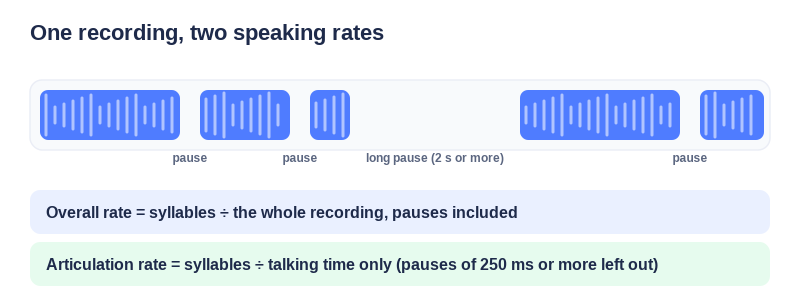
- Articulation rate: syllables per second while you are speaking, with pauses left out
- Overall rate: syllables per second including pauses
- Words per minute, for comparison with what you may have read elsewhere
- Pauses and long pauses (2 seconds or more), and your longest stretch without a pause
The free-speech number is labelled approximate, because it is counted from the sound of your voice rather than from a known passage. Background noise can add or hide syllables, so a quiet room gives the fairest reading.
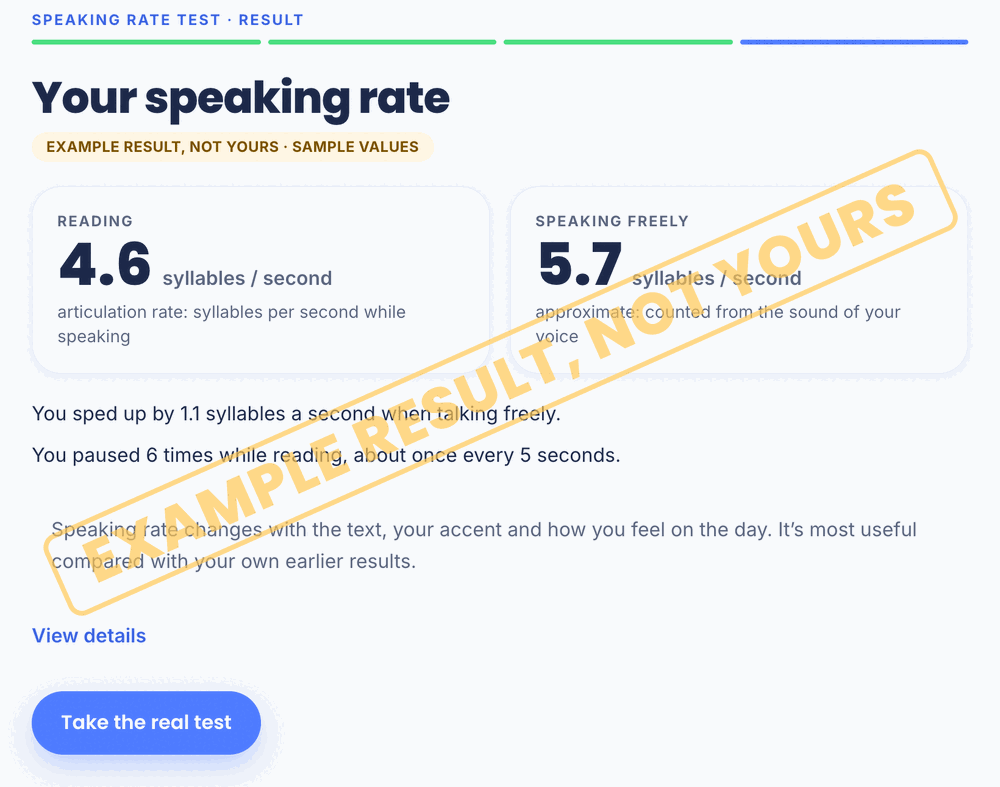
Free Speaking Rate Test
Read for 30 seconds, then talk freely for 30 seconds. Analysed on your device; indicative, not a diagnosis.
How practice works
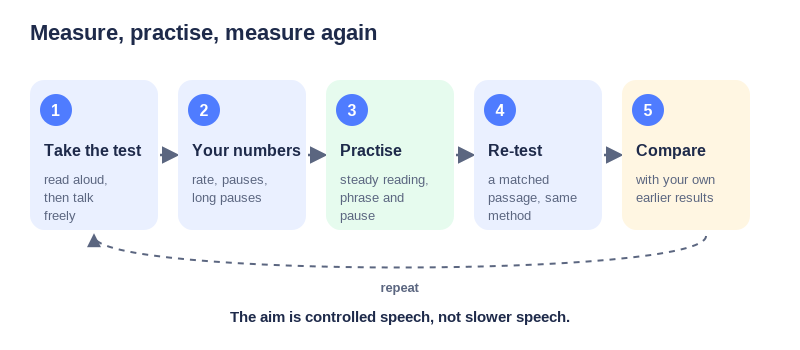
- 1Take the test to see where you start.
- 2Practise steady reading: a passage is highlighted at a steady guide pace and you read along.
- 3Practise phrases and pauses: ‖ marks show where to pause between phrases.
- 4Re-test with a matched passage, measured the same way, so the change is comparable.
- 5Compare with your own earlier results, task by task.
Feedback is neutral. You see what changed, never a grade, and results are kept by task, so reading is compared with reading and free talk with free talk.
Why pace and pauses, and not just speed
A review of clear-speech research reports that talkers can produce clear speech at conversational rates with training, and that this still helped listeners with simulated hearing losses in noise, a little less than clear speech at slow rates. In conversational speech, overall speaking rate showed no correlation with intelligibility in one study, or a correlation for some talkers but not all.2
That is why SpeechStep looks at speed as one part of clarity, alongside pauses and finished words.
In cluttering, ASHA notes that the speaker’s measured speech rate is not always greater than average, but the listener perceives it as rapid. A rate number on its own can’t say whether someone has a speech disorder.1
Who it’s for, and who it isn’t
- People who are told they talk too fast or rush their words
- People preparing to present, read aloud or record
- Teens practising with a parent’s account
- People working with an SLP who want to practise pace between sessions, with the SLP setting any target
It isn’t an English course, an accent course or a public-speaking programme, and it isn’t therapy. It won’t tell you that you have a condition, and it won’t set a target for you; if you see an SLP, they set the target.
When to see an SLP or a doctor
If speech changes suddenly, especially with face drooping or arm weakness, call your local emergency number. For ongoing worries about stuttering, cluttering or unclear speech, a speech-language pathologist can assess it.
Price and privacy
The free tools need no account. Pacing practice needs a free account; the first two pacing sessions are free, then it is part of Premium, which also includes speech-sound practice. See the pricing page for current plans and offers.
The free test analyses your voice on your device and doesn’t save the recording unless you create an account. Each use of a recording beyond your own feedback is a separate choice, off until you turn it on.
What SpeechStep can and can’t do
SpeechStep shows your pace and pauses and helps you practise. It is indicative, not a diagnosis, and it doesn’t measure loudness or voice quality.
Frequently asked questions
Is SpeechStep Pacing free?+
The speaking rate test, the words-to-minutes calculator, the syllable counter and the reading speed test are free and need no account. Pacing practice needs a free account: the first two pacing sessions are free, then it is part of Premium.
Does it tell me if I talk too fast?+
No. It shows your rate and your pauses and compares them with your own earlier results. Rate changes with the text, the task, your accent and the day, so a single number isn’t a verdict.
Can it tell whether I stutter or clutter?+
No. SpeechStep doesn’t identify, diagnose or treat stuttering, cluttering or any other condition. If you are worried about your speech, a speech-language pathologist (SLP) can assess it. Our page on finding support explains how to find one.
Is my recording saved?+
The free test analyses your voice on your device, and the recording isn’t saved unless you create an account. In practice, each use of a recording beyond your own feedback is a separate choice that is off until you turn it on.
Who is it for?+
Teens and adults who want to understand their speaking pace: people who are told they talk too fast, people preparing to present or read aloud, and people practising pace alongside their own SLP’s advice.
Practise your own speech, one sound at a time
Free with an account: your first practice day is a full session of 14 words, then 5 words a day, with AI feedback on the sounds it supports. SpeechStep is practice, not therapy, and it doesn’t diagnose.
Need a licensed professional? Where to find a speech-language pathologist
References
2 sources from authoritative bodies. Last reviewed November 2026.
- 1.ASHAStuttering, Cluttering, and Fluency — Practice Portal page.
- 2.Language and Linguistics CompassSpeaking and Hearing Clearly: Talker and Listener Factors in Speaking Style Changes — Journal article, 2009.
Keep reading
Speech Pace Test
What the free test measures and how to read your result.
Read →Why Talking Too Fast Makes You Hard to Follow
What listeners need, and why rate is only part of it.
Read →Controlled Speech, Not Slower Speech
What clear-speech research shows about pace.
Read →How SpeechStep Is Different
Speech practice, not an English course or a public-speaking app.
Read →