Speech Fluency Exercises: What Fluency Means and How It’s Practised
ASHA describes fluency as the continuity, smoothness, rate and effort of speech, and says all speakers are disfluent at times. Changing how often and where pauses fall can improve fluency and clarity. If you stutter, NIDCD advises working with a speech-language pathologist (SLP).
What fluency means
ASHA describes fluency as the continuity, smoothness, rate and effort of speech. It also points out that all speakers are disfluent at times. A fluency disorder is an interruption to the flow of speech that can affect how effectively and how willingly someone communicates.7
The NHS describes speech as a system that, when every part of it works well, produces the right words in the right order, with correct rhythm, pauses and emphasis.4
A review of clear-speech research reports that talkers can be trained to produce clear speech at conversational rates, and that this increased intelligibility for normal-hearing listeners with simulated hearing losses, in noise, though slightly less than clear speech at slow rates. The same review reports that, in studies of English conversational speech, overall speaking rate showed either no correlation with intelligibility or a correlation for some but not all talkers.6
Taken together, fluency isn’t only a matter of speed. Where you pause matters too, and the aim of practice is controlled speech, not slower speech.
Everyday disfluencies
ASHA’s consumer site says we all have moments when speech isn’t smooth: saying “uh” or “you know”, mispronouncing a word we know, or repeating a word. These are called typical disfluencies, and they are not considered stuttering.2,9
Fillers such as “uh” and “um” are among the most frequent types of disfluency, and estimates have put the rate of disfluencies in speech as high as 6 per 100 words. In one set of experiments, fillers helped listeners’ recall, while coughs of the same length impaired recall.21
So fluency practice isn’t about removing every “um”.
| Kind | How the source describes it |
|---|---|
| Typical disfluencies | Saying “uh” or “you know”, mispronouncing a familiar word, repeating words; we all have times like this |
| Stuttering | More, and different, disfluencies: repeating parts of words, stretching a sound out, getting stuck before or in the middle of a word |
| Cluttering | Fast speech, many non-stuttering disfluencies such as “uh” and “um”, unexpected pauses, some sounds said in a very exaggerated way |
How ASHA’s consumer site describes three kinds of disfluency. These are descriptions, not a checklist: the site notes it’s not always easy to tell if a child stutters and/or clutters.2
Stuttering, also called stammering, is a speech disorder involving repeated sounds, syllables or words, prolonged sounds, and blocks. It can change from day to day, with easier and harder times.10,9
Fluency practice for everyday speaking
In fluency work, ASHA describes changing how often and where pauses fall as a way to increase fluency and improve overall communication, such as message clarity, and notes that pausing is also an effective method of rate control.1
Where you pause matters. In a study with 27 normal-hearing young adults, adding silent pauses at linguistically salient points in a sped-up narrative brought recall back close to the level at the original, unaltered rate. The researchers note that pauses at random points unrelated to the clause structure give little or no improvement.20
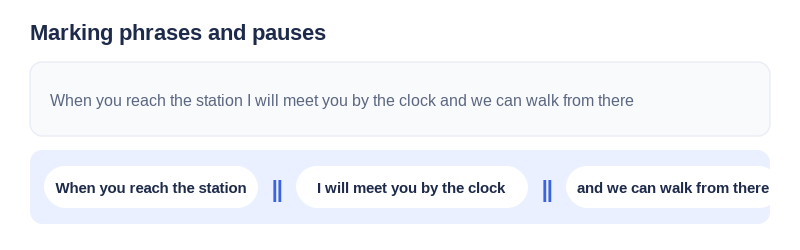
SpeechStep Pacing turns this into short exercises for teens and adults: steady reading, where a passage is highlighted at a steady guide pace; phrase pacing, where ‖ marks the pause, as in the example above; and pause practice. Feedback is neutral and results are kept by task. The aim is controlled speech, not slower speech.
Free Speaking Rate Test
Read a short passage aloud, then talk freely for 30 seconds. Analysed on your device; indicative, not a diagnosis.
Fluency practice for stuttering and cluttering
ASHA describes speech modification and stuttering modification as two different types of treatment approach for improving fluency. Speech modification, which includes fluency shaping, aims to change the timing and tension of speech or the frequency and placement of pauses; stuttering modification typically aims to reduce physical tension and struggle. They can be used separately or at the same time, and many clinicians integrate several approaches.8
ASHA lists easy onset, light contact, continuous phonation and prolonged syllables among speech modification techniques. A review found that speech restructuring therapy, also called fluency shaping or prolonged speech, has the most robust evidence base for adults, but maintaining control in everyday speaking situations can be very difficult. The Camperdown Program’s guide states that it is essential for a professionally qualified clinician to train and supervise adults and adolescents treated with it.8,17,19
Being told to “slow down” is something virtually everyone who stutters reports. Reduced speech rate is a component of many treatments, but on its own, the rate reduction needed for clinically useful stuttering reduction may not be functionally useful. STAMMA says there is no quick fix for stammering.18,14
Cluttering is different. ASHA notes that the measured rate is not always greater than average, even though listeners perceive it as rapid, and that fluency shaping approaches such as easy onset or continuous phonation may not be effective for cluttering. The RCSLT lists practising putting pauses in speech and working on awareness of listener reactions.1,15
These techniques are learned with a trained clinician, not from a web page. If you stutter or clutter, SpeechStep’s pacing practice is something to use with an SLP’s advice or within their plan, and any target is for the SLP to set. SpeechStep doesn’t identify, assess or treat either condition, and it doesn’t teach these therapy techniques.
Reading aloud as practice
The task changes how speech flows. NIDCD notes that speaking before a group or on the telephone may make stuttering more severe, while singing, reading or speaking in unison may temporarily reduce it. The International Cluttering Association says cluttered speech is often at its best in a structured situation where the person is actively monitoring it, such as being videotaped, and often at its worst when the person is more relaxed.3,16
Reading and talking freely also differ in pace. In a study of 192 speakers of two varieties of American English, articulation rate in reading was slower than in spontaneous speaking. ASHA adds that evaluation is more accurate when it includes self-report and samples of speech across various situations and tasks.5,1
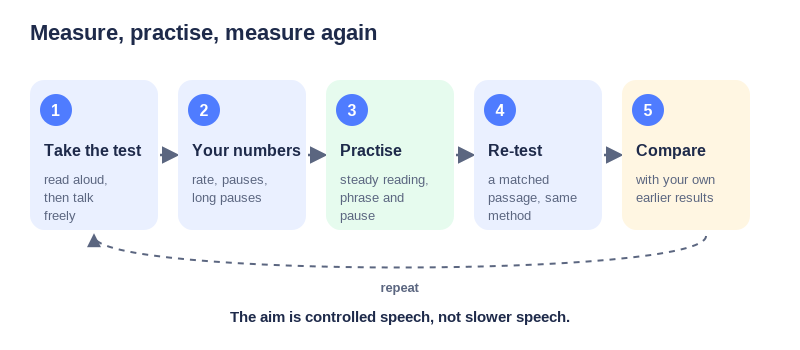
That’s why SpeechStep’s free speaking rate test has two parts: about 30 seconds of reading aloud, then 30 seconds of talking freely, shown side by side in syllables per second. It’s analysed on your device, the free-speech number is approximate, and the result is indicative, not a diagnosis; it doesn’t identify stuttering, cluttering or any other condition. Compare it with your own earlier results rather than anyone else’s.
- Pick a short passage you can reuse, about a paragraph long.
- Pencil in a mark at each place a phrase naturally ends.
- Read it aloud once and record it.
- Listen back for where your pauses fell and whether each phrase was easy to follow.
- Read the same passage again next week and compare the two recordings.
When to see an SLP
NIDCD advises that anyone who stutters work with a speech-language pathologist to determine the best treatment options. In the UK, the NHS says an adult whose stammering has a significant impact on social and work life may want to ask a GP for a referral to a speech and language therapist. The International Cluttering Association says a definitive diagnosis of cluttering can only be made by an SLP with experience and expertise in it.3,11,16
The Stuttering Foundation says that, in the vast majority of cases, the sudden appearance of disfluent speech in an adult should be considered “abnormal”. The NHS says to call 999 if somebody’s face droops on one side, if a person cannot lift up both arms and keep them there, or if a person has difficulty speaking, with speech that may be slurred or garbled. It says these can be signs of a stroke, which is a medical emergency, and that stroke symptoms usually come on suddenly.13,12
When to see an SLP
See an SLP if disfluency or unclear speech affects your work, relationships or willingness to speak; if listeners often can’t follow you; or if you want to learn fluency or stuttering techniques properly. If speech becomes slurred, garbled or disfluent suddenly, call your local emergency number at once, before anything else. The find support page explains how to find an SLP through your country’s register.
What SpeechStep can and can’t do
SpeechStep Pacing lets you measure your own speaking rate and pauses, practise steady reading, phrasing and pausing, and compare a re-test on a matched passage with your earlier results. An authorised reviewer may listen to eligible recordings if you opt in to human review. It is practice, not therapy: it doesn’t diagnose or treat stuttering, cluttering or any condition, doesn’t set targets, and doesn’t measure loudness or voice quality.
Frequently asked questions
What are speech fluency exercises?+
They are practice tasks for the flow of speech, which ASHA describes in terms of continuity, smoothness, rate and effort. ASHA describes changing how often and where pauses fall as a way to increase fluency, and notes that pausing is also an effective method of rate control. For stuttering, a programme such as Camperdown states that a qualified clinician must train and supervise the people using it.
How can I improve my speech fluency?+
One practical way is to read a passage aloud, record it, listen to where you paused, and compare with your own earlier recordings. ASHA describes changing where pauses fall as a way to increase fluency and clarity. A review reports that talkers can be trained to speak clearly at conversational rates, which increased intelligibility for normal-hearing listeners with simulated hearing losses, in noise. The aim is controlled speech, not slower speech.
Is it normal to say um and repeat words?+
Yes. ASHA’s consumer site calls saying “uh”, “you know” or repeating words typical disfluencies, and says they happen to many of us and are not considered stuttering. Estimates have put the rate of disfluencies in speech as high as 6 per 100 words.
Can fluency exercises help stuttering?+
A review found that speech restructuring, also called fluency shaping or prolonged speech, has the most robust evidence base for adults who stutter, though maintaining control in everyday speaking situations can be very difficult. The Camperdown Program, for example, states that a professionally qualified clinician must train and supervise the people using it. STAMMA notes there is no quick fix, and NIDCD advises working with an SLP to determine the best treatment options.
Does slowing down make speech more fluent?+
Not on its own. For stuttering, reduced speech rate is a component of many treatments, but the rate reduction needed for clinically useful stuttering reduction may not be functionally useful. For clarity, a review reports that clear speech at conversational rates increased intelligibility for normal-hearing listeners with simulated hearing losses, in noise, slightly less than clear speech at slow rates. The aim is controlled speech, not slower speech.
Can the speaking rate test tell me if I stutter?+
No. The test is indicative, analysed on your device and not a diagnosis, and it doesn’t identify stuttering, cluttering or any other condition. ASHA notes that in cluttering the measured rate is not always greater than average, even though listeners perceive it as rapid. A rate number alone can’t tell you about a condition; an SLP is the person to ask.
Practise your own speech, one sound at a time
Free with an account: your first practice day is a full session of 14 words, then 5 words a day, with AI feedback on the sounds it supports. SpeechStep is practice, not therapy, and it doesn’t diagnose.
Need a licensed professional? Where to find a speech-language pathologist
References
21 sources from authoritative bodies. Last reviewed November 2026.
- 1.ASHAStuttering, Cluttering, and Fluency — Practice Portal page.
- 2.CHSA (ASHA consumer site)Stuttering and Cluttering — Consumer page (asha.org/public now redirects here).
- 3.NIDCDWhat Is Stuttering? Diagnosis & Treatment — Health information page.
- 4.NHSStammering — Health A to Z page.
- 5.The Journal of the Acoustical Society of AmericaBetween-speaker and within-speaker variation in speech tempo of American English — Peer-reviewed study (PMC full text), 2010.
- 6.Language and Linguistics CompassSpeaking and Hearing Clearly: Talker and Listener Factors in Speaking Style Changes — Peer-reviewed review (PMC full text), 2009.
- 7.ASHAStuttering, Cluttering, and Fluency (definitions, prevalence, cluttering vs stuttering, adults) — Practice Portal page.
- 8.ASHAStuttering, Cluttering, and Fluency (treatment approaches for adults, support) — Practice Portal page.
- 9.ASHAStuttering and Cluttering — Consumer page.
- 10.NIDCDStuttering — Health information page, 2017.
- 11.NHS (nhs.uk)Stammering (overview) — Health A to Z page, 2023.
- 12.NHS (nhs.uk)Dysarthria (difficulty speaking) — Health A to Z page, 2023.
- 13.Stuttering Foundation of AmericaNeurogenic Stuttering — Brochure page.
- 14.STAMMA (British Stammering Association)Adult Stammering Options Explained — Information page.
- 15.Royal College of Speech and Language Therapists (RCSLT)Cluttering overview — Public clinical information page.
- 16.International Cluttering Association (compiled by K. Scaler Scott, F. Myers, P. Kissagizlis)What is Cluttering? — Information page.
- 17.Psychology Research and Behavior ManagementBlomgren M. Behavioral treatments for children and adults who stutter: a review — Review article (open access), 2013.
- 18.University of Technology Sydney / Australian Stuttering Research CentreOnslow M. Stuttering and its Clinical Management: Twelve Lectures — Clinical lecture book (August 2026 edition), 2026.
- 19.Australian Stuttering Research CentreO'Brian S. et al. The Camperdown Program Stuttering Treatment Guide — Treatment guide, 2018.
- 20.Trends in Hearing (SAGE, open access); PMC10637151Strategic Pauses Relieve Listeners from the Effort of Listening to Fast Speech (O'Leary, Neukam, Hansen, Kinney, Capach, Svirsky & Wingfield) — Journal article, 2023.
- 21.Journal of Memory and Language (Elsevier); NIH author manuscript PMC3134332The disfluent discourse: Effects of filled pauses on recall (Fraundorf & Watson) — Journal article, 2011.
Keep reading
Stuttering Techniques for Adults
What the main therapy techniques are and who teaches them.
Read →Phrase and Pause Practice
How phrasing and pauses shape clear, controlled speech.
Read →Reading Aloud Practice for Adults
Using a reusable passage to practise and compare over time.
Read →Cluttering Exercises
What therapy for cluttering involves, and why pausing matters.
Read →