Cluttering Exercises and Treatment: What an SLP Might Use
Cluttering therapy can include practising pauses, building awareness of your own speech and of listener reactions, and learning to adjust your rate. A diagnosis comes from an SLP with cluttering experience. Practise between sessions on their advice.
What cluttering treatment aims for
Cluttering is a fluency disorder that involves speech that sounds rapid, unclear or disorganised. ASHA lists its signs as a speech rate perceived to be “abnormally rapid” and/or irregular, an excessive number of non-stuttering disfluencies, frequent irregular pausing, and over-coarticulated speech, such as dropped word endings or collapsed syllables.3,1
In their textbook on cluttering, van Zaalen and Reichel list four aims for therapy: problem identification, reducing speech rate, facilitating appropriate pauses and facilitating appropriate monitoring. They list problem identification first, and say of one exercise that it is useless if clients are unable to identify their symptoms.11
On rate, the same authors say the primary concern is not the number of syllables per second but whether speakers are able to adjust their speaking rate. The RCSLT notes that people who clutter may not be able to adjust their rate of speech.10,7
The RCSLT says these strategies can be effortful and may only be used some of the time. ASHA notes that some people have negative feelings about using speech modification strategies, much as people who stutter can about showing stuttering.7,1
Pausing and phrasing
ASHA describes strategies that change how often and where pauses fall, used to increase fluency and improve overall communication, and says pausing is also an effective method of rate control. The Stuttering Foundation explains that people who clutter tend to pause less often than other speakers, so inserting pauses in natural places is one way to reach a rate their system can handle, and that the person often has to be taught to pause deliberately.1,3
The RCSLT describes practising putting pauses in speech to slow it down overall, make it easier to understand and give more time to organise what is being said.7
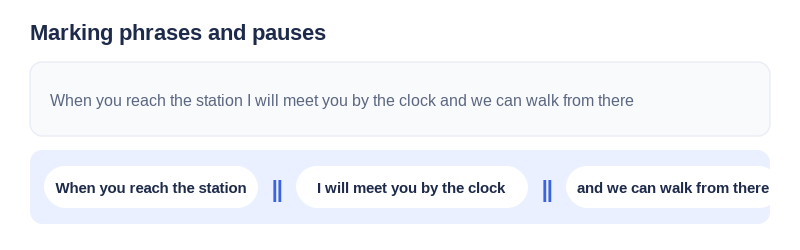
As the illustration shows, one long sentence can be split into shorter phrases, with a mark where each pause goes. This is the format SpeechStep uses in its phrase pacing exercise.
The Stuttering Foundation says that for some people, slowing rate by adding pauses is enough to increase speech clarity, while for others, unclear speech still exists between the pauses.3
Rate, articulation and self-monitoring
ASHA notes that the speaker’s measured rate is not always greater than average, though the listener perceives it as rapid. The Stuttering Foundation describes a rate that is “too fast” for that speaker’s system to handle.1,3
ASHA lists strategies that include having the person simulate a fast rate and then apply pausing, simulating over-articulated speech and adding emphasis, overemphasising long words and word endings, and increasing awareness of when communication breaks down, for example by watching how listeners react.1
Van Zaalen and Reichel describe an internal feedback loop of self-observation, self-judgment and self-correction that is often very slow to develop. The RCSLT describes therapy work on awareness of your own speech and of listener reactions, including recognising when speech is “too fast”.11,7
ASHA notes that fluency shaping approaches such as easy onset or continuous phonation may not be effective for cluttering. It also says some people who clutter have decreased loudness at the ends of sentences or phrases and may benefit from learning to keep a steady volume.1
Listening back to your own speech
The International Cluttering Association says that, unlike stuttering, many people who clutter are unaware of their difficulties with communication. ASHA says evaluation is more accurate when it includes self-report and samples of speech across various situations and tasks, such as recordings of speech outside the clinic.8,1
The Stuttering Foundation lists temporary improvement when a person is asked to “slow down” or pay attention to speech, or when being recorded. The International Cluttering Association says cluttering behaviours are more likely to surface as the speaking task is more extemporaneous and informal, less structured, more emotional and linguistically more complex.3,9
Van Zaalen and Reichel’s textbook describes a study in which 12 male adolescents and adults with cluttering received weekly audio-visual feedback training over a 12-week period, with a follow-up after three months. It also gives a case example in which this training resulted in improved awareness of and control over one person’s speech.11
Free Speaking Rate Test
Read a short passage aloud, then talk freely for 30 seconds. Analysed on your device; indicative, not a diagnosis.
The free speaking rate test records both kinds of speech: a short passage read aloud, then 30 seconds of free talk, with each part’s rate in syllables per second side by side. It’s analysed on your device, the result is indicative, not a diagnosis, and it doesn’t identify cluttering or any other condition. Use it to compare with your own earlier results, and take your notes to your SLP.
Practising between sessions
If you’re working with an SLP, practise between sessions within their plan, using the strategies they choose and any targets they set.
Van Zaalen and Reichel recommend short periods of intense training, ten to twelve weeks per goal. They also say people who clutter should not be asked to speak at the mean articulatory rate of the general population.11
- Ask your SLP which one strategy to work on this week, such as pausing at the end of each phrase.
- Practise in free talk as well as reading aloud.
- Record the same kind of task each time so your recordings can be compared.
- Note moments when someone asked you to repeat yourself, and bring them to your next session.
- Ask a friend you trust to tell you when they can’t follow you.
STAMMA says it can help a person who clutters if you make them aware when you can’t understand them, so they can use strategies like pausing between phrases and sentences or over-articulating certain words.4
If your SLP suggests pacing practice, SpeechStep Pacing has phrase pacing, where ‖ marks show where to pause, plus pause practice and steady reading at a steady guide pace, with neutral feedback and a re-test on a matched passage. The aim is controlled speech, not slower speech. SpeechStep doesn’t treat cluttering; it’s a place to practise what your SLP has asked you to work on.
What the evidence says
The RCSLT says research about cluttering is limited. A 2026 review of studies in children and adolescents described cluttering as reflecting a developmental vulnerability in motor–cognitive integration rather than a purely rate-based fluency disturbance, and said significant evidence gaps remain.7,13
Tomisato and colleagues note that the common definition of cluttering is highly subjective, with little interprofessional agreement for diagnosing it based on subjective evaluation of speech symptoms.12
Van Zaalen and Reichel state there is no empirical support for using delayed or frequency-altered auditory feedback in cluttering. ASHA cautions that if fluency improves dramatically when someone slows their speech, that may point to cluttering but is not definitive, because similar changes may also occur with stuttering.11,1
A 2009 review of clear speech in general, not cluttering, reports that talkers trained to speak clearly at conversational rates increased intelligibility for normal-hearing listeners with simulated hearing losses, in noise, though slightly less than clear speech at slow rates. The same review notes that in studies of English conversational speech, overall speaking rate showed either no correlation with intelligibility or a correlation for some but not all talkers.5
Finding an SLP who knows cluttering
When to see an SLP
See a speech-language pathologist if people often ask you to repeat yourself or say they can’t follow you, or if the way you speak is affecting work, study or confidence. Mention anything else you’ve been told about your learning, language or attention. If a change in your speech comes on suddenly, see a doctor first. Our find-support page explains how to search your country’s register.
The International Cluttering Association says a definitive diagnosis of cluttering can only be made by an SLP with experience and expertise in it, and that one with expertise in fluency disorders is often the ideal professional. In the UK, STAMMA notes that speech and language therapists who specialise in stammering can also support people who clutter. The RCSLT says cluttering typically presents alongside one or more other differences, such as stammering, dyslexia, dyspraxia, ADHD, developmental language disorder or autism.8,4,7
In the US, ASHA’s ProFind lists certified SLPs. In the UK, the RCSLT describes three routes for adults: referral by a GP, self-referral to the local speech and language therapy service, or contacting a private speech and language therapist directly.2,6
What SpeechStep can and can’t do
SpeechStep is practice, not therapy. The speaking rate test is indicative, analysed on your device and not a diagnosis; it doesn’t identify cluttering, and rate alone can’t show whether someone clutters. Pacing practice works on pauses, phrasing and steady reading. SpeechStep doesn’t measure loudness or voice quality, doesn’t offer delayed auditory feedback, and doesn’t deliver any named therapy programme.
Frequently asked questions
What are good cluttering exercises?+
ASHA lists strategies such as simulating a fast rate and then applying pausing, over-articulating with added emphasis, overemphasising long words and word endings, and noticing when a listener has lost the thread. The RCSLT describes practising putting pauses in speech to make it easier to understand and give more time to organise what is being said. Your SLP chooses which ones fit you.
How do I stop cluttering speech?+
The sources describe strategies to make speech easier to understand, such as practising pauses. The RCSLT notes these strategies can be effortful and may only be used some of the time. A definitive diagnosis of cluttering can only be made by an SLP with experience of it. Talk to one about which strategies to use.
Does slowing down help cluttering?+
ASHA says that when a person is asked to increase pausing or reduce their rate during assessment, a reduction of overall rate typically helps reduce cluttering symptoms, and that pausing is an effective method of rate control. The Stuttering Foundation notes that for some people, unclear speech still exists between the pauses. The aim is controlled speech, not slower speech.
Does easy onset or fluency shaping work for cluttering?+
ASHA notes that fluency shaping approaches such as easy onset or continuous phonation may not be effective for cluttering. Van Zaalen and Reichel also state there is no empirical support for using delayed or frequency-altered auditory feedback in cluttering. Choosing techniques is a job for a clinician.
Can a speaking rate test tell me if I clutter?+
No. ASHA notes that the measured rate in cluttering is not always greater than average, even when listeners perceive it as rapid. SpeechStep’s speaking rate test is indicative, analysed on your device and not a diagnosis, and it doesn’t identify cluttering. A definitive diagnosis comes from an SLP with cluttering experience.
Is cluttering speech therapy effective?+
The RCSLT says research about cluttering is limited, and a 2026 review said significant evidence gaps remain. Van Zaalen and Reichel’s textbook describes a study of weekly audio-visual feedback training with 12 male adolescents and adults over 12 weeks. Ask an SLP with cluttering experience what they would suggest for you.
Practise your own speech, one sound at a time
Free with an account: your first practice day is a full session of 14 words, then 5 words a day, with AI feedback on the sounds it supports. SpeechStep is practice, not therapy, and it doesn’t diagnose.
Need a licensed professional? Where to find a speech-language pathologist
References
13 sources from authoritative bodies. Last reviewed November 2026.
- 1.ASHAStuttering, Cluttering, and Fluency — Practice Portal page.
- 2.ASHAFind Certified Audiologists and Speech-Language Pathologists (SLPs) — Directory of certified professionals.
- 3.Stuttering FoundationCluttering — Brochure (written by fluency researchers).
- 4.STAMMA (British Stammering Association)Cluttering — Information page.
- 5.Language and Linguistics CompassSpeaking and Hearing Clearly: Talker and Listener Factors in Speaking Style Changes — Peer-reviewed review (PMC full text), 2009.
- 6.Royal College of Speech and Language Therapists (RCSLT)Stammering overview — Public clinical information page, 2025.
- 7.Royal College of Speech and Language Therapists (RCSLT)Cluttering overview — Public clinical information page.
- 8.International Cluttering Association (compiled by K. Scaler Scott, F. Myers, P. Kissagizlis)What is Cluttering? — Information page.
- 9.International Cluttering Association, Clinical Issues Committee (van Zaalen, Myers, Ward, Bennett)Cluttering Assessment — Clinical guideline page.
- 10.Routledge (TalkBank copy)van Zaalen, Y. & Reichel, I. An Introduction to Cluttering (theory and assessment chapters) — Book, 2024.
- 11.Routledge (TalkBank copy)van Zaalen, Y. & Reichel, I. An Introduction to Cluttering (therapy chapters) — Book, 2024.
- 12.Frontiers in PsychologyTomisato S. et al. Speech characteristics that differentiate stuttering and cluttering in Japanese speakers — Journal article (open access, CC BY), 2024.
- 13.Children (Basel), MDPIHan W. et al. Cluttering in Children and Adolescents: Speech Motor Development, Neurocognitive Mechanisms, and Allied Health Implications — Systematic review (open access, CC BY), 2026.
Keep reading
Cluttering
What cluttering is and how it’s described by professional bodies.
Read →Cluttering in Adults
Why many adults who clutter are only diagnosed later in life.
Read →Cluttering vs Stuttering
How the two fluency disorders differ, and how they can occur together.
Read →Phrase and Pause Practice
How phrase pacing and pause practice work in SpeechStep Pacing.
Read →