Speech Rhythm: Stress, Timing and Pauses
Speech rhythm has no agreed definition; a common one is the alternation of stressed and unstressed syllables, which English listeners use to find word boundaries. Well-placed pauses aid recall, random ones barely help, and slow speech alone didn’t improve intelligibility in one study.
What speech rhythm is
Speech carries a rhythm as well as words. The NHS describes smoothly working speech as the right words in the right order, with correct rhythm, pauses and emphasis.2
A related term is prosody, the full array of features that sit on top of individual sounds. These include the pitch pattern of a sentence, word stress (which is based on loudness), pitch and syllable length, plus timing variations such as the pauses that sometimes occur between the main parts of a sentence and the lengthening of the last word in a clause.11
There is no agreed definition of speech rhythm. One common meaning is the alternation of stressed and unstressed syllables, sometimes called contrastive rhythm.12
Speech carries quasi-regular rhythmic information in its slow rises and falls in loudness, which arise from the jaw opening and closing, coupled with voicing. Even so, regular timing is far more obvious to the listener’s ear than it is in the sound wave itself.10
Stress: the beats of a word and a sentence
ASHA describes stress as the prominence or emphasis on a particular part of an utterance or a syllable. It describes intonation as the pitch pattern that changes within and across words and affects meaning.14
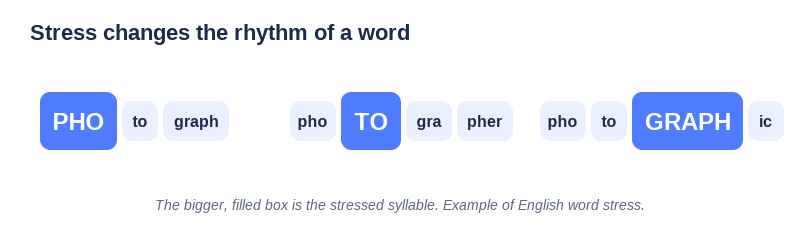
English is perceived as having a strong length contrast between stressed and unstressed syllables, and listeners rely on that contrast to work out where one word ends and the next begins.12
Across a sentence, stressed syllables are constrained to fall at predictable times, shaped by the language and by the speaker’s own movements. That predictability helps listeners understand and helps speakers keep in step with each other, and when speech rate varies, the stress pattern changes in predictable ways too.10
Pauses and phrases
Pauses sometimes occur between the major parts of a sentence, and lengthening the last word of a clause is a common marker in English that a clause is ending. Listeners, older adults included, use these prosodic cues to chunk what they hear into meaningful pieces.11
Where a pause falls matters. In one experiment with 27 normal-hearing young adults, adding silent pauses at linguistically important points in sped-up speech brought story recall back close to its level at the original, unaltered rate, while pauses placed at random points unrelated to the clause structure gave little or no improvement.8
Public-speaking teachers describe pauses as vocal punctuation. They advise pausing after a complete thought to give listeners time to think, but not so long or so often that it makes the audience uncomfortable.18
SpeechStep’s free speaking rate test can show you your own pauses. You read a short passage aloud, then talk freely for 30 seconds; “View details” adds your pauses, long pauses (2 seconds or more) and articulation rate, which leaves out pauses of 250 ms or more. It is analysed on your device, the results are indicative, not a diagnosis, and it doesn’t identify stuttering, cluttering or any other condition. The most useful comparison is with your own earlier results.
Free Speaking Rate Test
Read a short passage aloud, then talk freely for 30 seconds. Analysed on your device; indicative, not a diagnosis.
Rhythm and being understood
When researchers digitally reduced one prosodic feature at a time (pitch variation, loudness variation or timing variation), timing variation was the most valuable of the three for both younger and older listeners working out sentence structure.11
When people try to be easier to understand, they typically speak more slowly and more loudly and articulate sounds in a more exaggerated way. Naturally produced clear speech also includes longer and more frequent pauses.3
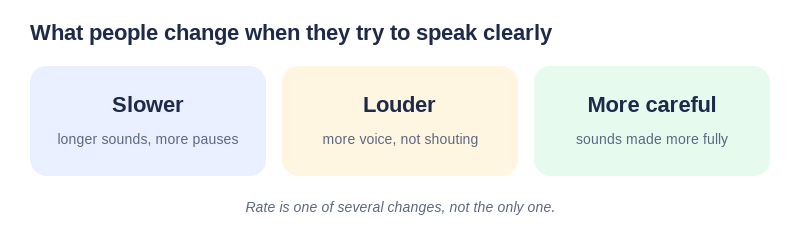
Slowing down is one of a wide range of adjustments in clear speech. A review reports that talkers trained to speak clearly at conversational rates still became more intelligible to normal-hearing listeners with simulated hearing losses, in noise, and that in studies of English conversational speech, overall speaking rate showed either no correlation with intelligibility or a correlation for only some talkers. In a study of 78 speakers reading sentences mixed with multitalker babble, loud and clear speech improved intelligibility but slow speech did not, and for the control speakers slow speech was less intelligible than their usual speech; a slower rate than usual is also associated with a narrower pitch range across a phrase.3,9
Accents are marked by variations in sounds, prosody, rate and fluency, and these may affect intelligibility, but ASHA notes that a person can have a noticeable accent and still be clearly intelligible.14
Practising rhythm with phrases and pauses
In SpeechStep Pacing, the phrase pacing exercise marks a passage with ‖ wherever to pause, as the illustration shows. Steady reading highlights a passage at a steady guide pace, and pause practice works on pauses on their own. Feedback is neutral, results are kept by task, and a re-test uses a matched passage with the same method so the change is comparable. The aim is controlled speech, not slower speech.
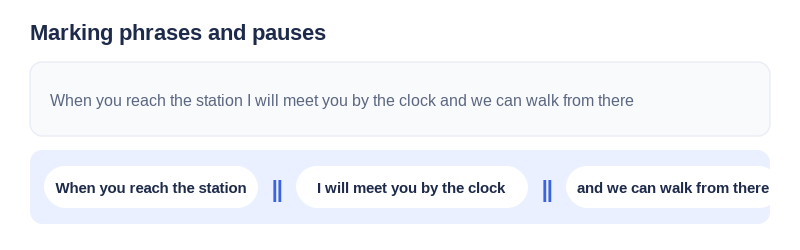
- 1Choose a short paragraph and mark a ‖ at each comma, each full stop and wherever a complete thought ends.
- 2Read it aloud with a brief pause at each mark, letting the last word before each pause land fully.
- 3Read one sentence three times, stressing a different word each time, and listen to how the meaning shifts.
- 4Record the reading, listen back, and note one place where the phrases ran together.
- 5Next week, read the same paragraph in the same way and compare it with your earlier recording, treating any single recording as a snapshot rather than a verdict.
MIT’s communication guidance notes that it’s hard to self-assess the rate you’re speaking at, and suggests recording yourself. In a study of 10 talkers who repeated the same speech tasks, speaking rate and other measures could change significantly from one repetition of a task to the next, especially in conversational style.19,20
What SpeechStep can and can’t do
SpeechStep can show your rate and pauses on the free speaking rate test, analysed on your device, and give you structured steady reading, phrase pacing and pause practice in SpeechStep Pacing (a free account, with the first two pacing sessions free, then Premium). If you opt in, an authorised SpeechStep reviewer may listen to eligible recordings. It does not measure loudness or voice quality, does not offer delayed auditory feedback, and does not identify, assess or treat any speech condition. Results are indicative, not a diagnosis, and practice is not therapy.
When rhythm changes are a sign to see an SLP
If speech changes suddenly, treat it as an emergency, not a rhythm issue. The NHS says to call 999 if someone’s face droops on one side, they cannot lift both arms and keep them there, or they have difficulty speaking, because these can be signs of a stroke, whose symptoms usually come on suddenly. ASHA’s public guidance says to call 911 for any sudden change in speech or communication and to see a doctor right away about any new difficulty talking.4,16
Some rhythm patterns are part of conditions an SLP looks at. ASHA lists the signs of cluttering as a speech rate perceived to be “abnormally rapid” and/or irregular, many non-stuttering-like disfluencies, frequent irregular patterns of pausing and over-coarticulated speech, and notes that the measured rate is not always greater than average. The RCSLT adds pausing in unusual places and using lots of filler words.1,5
In dysarthria, ASHA’s list of prosody signs includes short rushes of speech, excessive and equal stress, prolonged intervals and atypical silences. The MS Trust describes some people with more advanced MS sounding ‘robotic’ when rhythm and intonation are disrupted, sometimes called scanning speech, and a multicentre UK trial lists an irregular speech rhythm among the features of Parkinson’s-related dysarthria.15,6,7
When to see an SLP
If speech changes suddenly, call your local emergency number. See a licensed speech-language pathologist (SLP), or a doctor first, if your rhythm or clarity has changed gradually, if people often ask you to repeat yourself, or if you’ve been told your speech is rushed or hard to follow and want to know why. A rate number can’t tell you any of this, and SpeechStep’s tools don’t identify conditions. If practice would help, do it with your SLP’s advice and any targets they set. Our find support page explains how to find an SLP through your country’s register.
Frequently asked questions
What is speech rhythm?+
Speech rhythm has no single agreed definition. A common meaning is the alternation of stressed and unstressed syllables, sometimes called contrastive rhythm. English is perceived as having a strong length contrast between stressed and unstressed syllables, and listeners rely on it to find word boundaries.
Is prosody the same as speech rhythm?+
Not exactly. Prosody is a broad term for the features that sit above individual sounds, such as stress, intonation, pitch, timing and loudness. One common meaning of speech rhythm is narrower: the alternation of stressed and unstressed syllables, though rhythm has no agreed definition.
What is word stress?+
Word stress is the prominence or emphasis on a particular syllable. English is perceived as having a strong length contrast between stressed and unstressed syllables, and listeners use that contrast to work out where words begin and end.
How can I improve my speech rhythm?+
In one experiment with sped-up speech, pauses at linguistically important points restored listeners’ recall, while pauses at random points gave little or no improvement. Public-speaking guidance suggests pausing after complete thoughts and recording yourself, because it’s hard to judge your own rate as you speak. Try reading the same passage in phrases each week and comparing recordings. The aim is controlled speech, not slower speech.
Should I stop saying um?+
Not necessarily. Estimates have placed disfluencies in natural speech as high as 6 per 100 words, and in one set of experiments with recorded story passages, fillers helped listeners recall the story while coughs of the same length made recall worse. If fillers crowd your speech, you could try a short silent pause instead.
Does my accent affect my speech rhythm?+
It can shape it. ASHA says accents are marked by variations in sounds, prosody, rate and fluency, which may affect intelligibility, and that you can have a noticeable accent and still be clearly intelligible. SpeechStep doesn’t aim to change accents.
Practise your own speech, one sound at a time
Free with an account: your first practice day is a full session of 14 words, then 5 words a day, with AI feedback on the sounds it supports. SpeechStep is practice, not therapy, and it doesn’t diagnose.
Need a licensed professional? Where to find a speech-language pathologist
References
20 sources from authoritative bodies. Last reviewed November 2026.
- 1.ASHAStuttering, Cluttering, and Fluency — Practice Portal page.
- 2.NHSStammering — Health A to Z page.
- 3.Language and Linguistics CompassSpeaking and Hearing Clearly: Talker and Listener Factors in Speaking Style Changes — Peer-reviewed review (PMC full text), 2009.
- 4.NHS (nhs.uk)Dysarthria (difficulty speaking) — Health A to Z page, 2023.
- 5.Royal College of Speech and Language Therapists (RCSLT)Cluttering overview — Public clinical information page.
- 6.MS Trust (UK charity)Speech problems (last updated 1 January 2022) — Patient information page, 2022.
- 7.The BMJ (open access)Lee Silverman voice treatment versus NHS speech and language therapy versus control for dysarthria in people with Parkinson's disease (PD COMM): pragmatic, UK based, multicentre, three arm, parallel group, unblinded, randomised controlled trial — Journal article (randomized controlled trial), 2024.
- 8.Trends in Hearing (SAGE, open access); PMC10637151Strategic Pauses Relieve Listeners from the Effort of Listening to Fast Speech (O'Leary, Neukam, Hansen, Kinney, Capach, Svirsky & Wingfield) — Journal article, 2023.
- 9.Journal of Speech, Language, and Hearing Research (ASHA); NIH author manuscript PMC5564324Impact of Clear, Loud, and Slow Speech on Scaled Intelligibility and Speech Severity in Parkinson’s Disease and Multiple Sclerosis (Tjaden, Sussman & Wilding) — Journal article, 2014.
- 10.Frontiers in Psychology (open access, CC BY); PMC3434440Neural Oscillations Carry Speech Rhythm through to Comprehension (Peelle & Davis) — Journal article (review), 2012.
- 11.Experimental Aging Research (Taylor & Francis); NIH author manuscript PMC2867101Components of Speech Prosody and Their Use in Detection of Syntactic Structure by Older Adults (Hoyte, Brownell & Wingfield) — Journal article, 2009.
- 12.Journal of Speech, Language, and Hearing Research (ASHA); NIH author manuscript PMC3738185Quantifying Speech Rhythm Abnormalities in the Dysarthrias (Liss, White, Mattys, Lansford, Lotto, Spitzer & Caviness) — Journal article, 2009.
- 13.Journal of Memory and Language (Elsevier); NIH author manuscript PMC3134332The disfluent discourse: Effects of filled pauses on recall (Fraundorf & Watson) — Journal article, 2011.
- 14.ASHAAccent Modification (Practice Portal) — Professional practice guidance page.
- 15.ASHADysarthria in Adults (Practice Portal) — Professional practice guidance page.
- 16.ASHADysarthria — Public information page, 2026.
- 17.Stanford University, Oral Communication ProgramDelivery — University teaching resource page.
- 18.University of Tennessee, Knoxville, Tennessee Online Public Speaking Center (TOPS)Vocal Delivery — University teaching resource page.
- 19.Massachusetts Institute of Technology, Biological Engineering Communication Lab (CommKit)Public Speaking: Verbal — University teaching resource page.
- 20.Journal of the Acoustical Society of America; PMC10990565 (checker reads the abstract)Within-talker and within-session stability of acoustic characteristics of conversational and clear speaking styles (Ferguson, Morgan & Hunter) — Journal article (abstract excerpts), 2024.
Keep reading
Phrase and Pause Practice
Mark a passage into phrases and practise the pauses between them.
Read →Pausing When Speaking
Why well-placed pauses help listeners follow you.
Read →How to Enunciate
Clearer sounds and what clear speech involves beyond slowing down.
Read →Talking Too Fast?
What people mean by fast speech, and what helps listeners.
Read →