Rate Control in Speech Therapy
Rate control means strategies such as pacing and pausing, used in therapy for dysarthria, cluttering and stuttering. Cues to slow down don’t make speech clearer for every speaker, and for dysarthria the right strategy depends on its cause and type.
When rate control is used
If speech changes suddenly
Speech that changes suddenly, such as slurred or garbled speech or stuttering that starts out of the blue, can be a sign of a stroke, especially with a drooping face or an arm that can’t be lifted. Call your local emergency number straight away (999 in the UK, 911 in the US), even if the symptoms stop. If your speech has changed gradually and you’re worried, see a doctor.
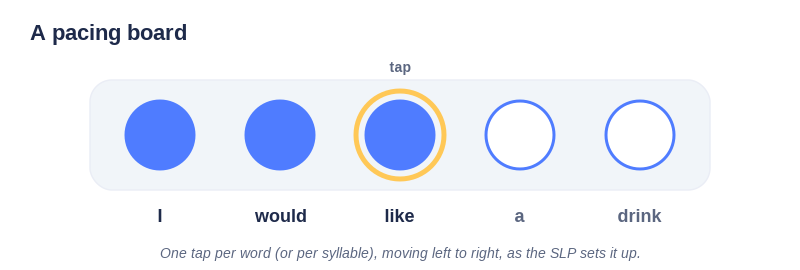
In its fluency guidance, ASHA describes rate control as “slowing the overall rate of speech”, and says strategies that alter the frequency and placement of pauses are used to increase fluency and improve communication, with pausing also an effective method of rate control. In ASHA’s guidance on dysarthria in adults, strategies for reduced speaking rate include pacing with hand tapping, a pacing board or a metronome, and delayed auditory feedback.1,11
Dysarthria is a group of neurogenic speech disorders characterised by abnormalities in the strength, speed, range, steadiness, tone or accuracy of the movements used for speaking. One explanation for slowing down is that a slower rate gives speakers with dysarthria more time to reach vocal tract shapes that are more distinct from one another. Hypokinetic dysarthria in Parkinson’s often results in increased speech rate or acceleration during utterances, which is why rate reduction is a common therapeutic technique.11,15,17
Rate and pausing also come up in fluency disorders. The Stuttering Foundation says it is common for people who clutter to pause less than speakers without cluttering, and that they often must be taught to pause deliberately in natural places. For teens and adults who stutter, many current therapies focus on ways to minimise stuttering, such as speaking more slowly.3,2
Methods: pacing, pausing and cues
Lowit and colleagues describe several ways to reduce rate, including pacing by finger tapping, a pacing board or a metronome, and note that less impaired speakers are often asked to pace themselves without external aids. Parkinson’s UK describes pacing boards, physical or digital, as aids that let you count out your words more slowly, and advises using the specific strategies your therapist has given you.16,14
ASHA describes phrase grouping, where for each breath the speaker says only the number of syllables that can be comfortably produced, and matching breaths to natural pauses in speech. In cluttering, the Royal College of Speech and Language Therapists lists practising putting pauses in speech to slow it down overall, make it easier to understand and give more time to organise what is being said.11,7
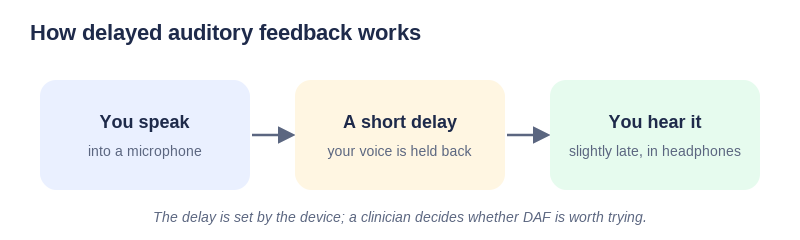
Delayed auditory feedback (DAF) devices play your voice back to you a fraction of a second after you speak. Lowit and colleagues explain that hearing your speech altered in this way disrupts the usual auditory feedback loop, which causes the speaker to slow down. In a reading task with 16 speakers with Parkinson’s and 11 control speakers, altered feedback (delayed or frequency-shifted) brought a prominent reduction in speech rate in all groups, but intelligibility and naturalness fell for all or some of the groups, while some speakers with Parkinson’s still benefited.6,16,17
Rate and naturalness
Slowing down can have a cost: speech produced by people with dysarthria at a “slower-than-normal” rate tends to be perceived as less natural than speech at a habitual rate, whether or not the slower rate improves intelligibility. Knowles and colleagues quote the aim of identifying a target rate that “will allow an optimal level of intelligibility without degrading naturalness unnecessarily”.15,19
Stuttering treatment meets the same trade-off. Onslow describes speech restructuring as a trade-off between speech with fewer stuttering moments and speech that sounds natural, and the Camperdown Program guide says clients decide their own goals, with some putting natural-sounding speech first even if that involves some stuttering. Blomgren notes that the final rate varies for each client.9,10,8
Research on clear speech points the same way. Talkers trained to produce clear speech at conversational speaking rates still increased intelligibility for normal-hearing listeners with simulated hearing losses, in noise, though to a slightly smaller degree than clear speech at slow rates.5
SpeechStep’s pacing practice is built around the same idea: the aim is controlled speech, not slower speech.
What research says
ASHA’s summary of a 2007 systematic review of dysarthria treatments, in which 76% of studies primarily targeted people with Parkinson’s, found preliminary evidence of potential benefit from rate control and said further research is warranted. It notes that the evidence is limited by the small number of studies and the mix of treatment techniques and participants.12
| Study | Who took part | What the results showed |
|---|---|---|
| Yorkston et al. 2007 review (ASHA summary) | People with neurologic conditions such as TBI, stroke, Parkinson’s and MS; 76% of studies mainly targeted Parkinson’s | Preliminary evidence of potential benefit from rate control; further research warranted |
| Van Nuffelen et al. 2010 (reported by Tjaden et al.) | Speakers with a variety of dysarthrias and neurological diagnoses, reading passages | Group intelligibility decreased with each of seven rate-control methods compared with habitual speech |
| Tjaden, Sussman & Wilding 2014 | 78 speakers reading sentences, including speakers with mild dysarthria due to MS or Parkinson’s; heard in multitalker babble | Loud and clear speech improved intelligibility; slow speech did not |
| Lowit et al. 2010 | 10 participants, once-weekly sessions for 6 weeks of traditional rate methods and altered auditory feedback | No group change in rate or intelligibility with either treatment type; some individuals improved |
| van Brenk, Kain & Tjaden 2021 | 7 speakers with dysarthria due to MS | Slowing improved intelligibility for 4 speakers and reduced it for 3 |
| Knowles, Adams & Jog 2021 | Participants reading sentences and giving monologues at seven self-selected rates | Slower-than-habitual rates were not associated with intelligibility changes; faster-than-habitual rates were associated with declines |
Selected studies of slowing speech. These are group results; individuals often differed.12,15,16,21,19
In a study of 50 speakers (7 older individuals and 43 speakers with dysarthria) reading a passage in habitual, loud and slow modes, cues to speak louder and reduce rate did not bring intelligibility benefits to every speaker, and speakers with a breathier voice quality tended to do better in the loud condition than the slow one. Lowit and colleagues add that the relationship between reducing rate and intelligibility is not always straightforward.20,16
In stuttering, Onslow notes that the rate reduction needed for a clinically useful drop in stuttering may not be functionally useful; for the severest participants in the example he gives, a 30% speech rate reduction reduced stuttering severity by 35%, leaving considerable stuttering. In cluttering, the Stuttering Foundation says slowing rate by adding pauses is enough to increase clarity for some people, while for others unclear speech still exists between the pauses.9,3
Measuring rate between sessions
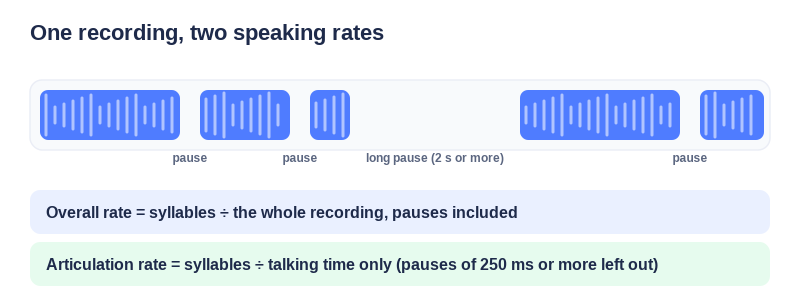
Researchers separate two measures. Chon and colleagues describe overall speaking rate as words or syllables per minute or second, including disfluencies and pauses shorter than 1–2 seconds. Articulation rate leaves pauses out: Jacewicz and colleagues measure it in syllables per second excluding pauses, which conveys more closely the pace at which speech segments are actually produced, and some investigators delete pauses longer than 250 ms.22,4
Rate also shifts with the task. In a study of 192 speakers of American English, articulation rate in reading was slower than in spontaneous speaking. In another study, which measured speaking rate and other acoustic characteristics in ten talkers, statistically significant changes could occur from one repetition of a speech task to the next, especially in the conversational style. ASHA notes that in cluttering the speaker’s measured rate is not always greater than average, though listeners perceive it as rapid.4,23,1
Free Speaking Rate Test
Read a short passage aloud, then talk freely for 30 seconds. Analysed on your device; indicative, not a diagnosis.
A rate number on its own can’t tell you anything about a condition, so compare with your own earlier results on the same kind of task rather than with anyone else. SpeechStep’s speaking rate test asks you to read a short passage aloud and then talk freely for 30 seconds, and shows each part’s rate in syllables per second side by side. View details adds overall rate (pauses included), articulation rate (pauses of 250 ms or more left out), words per minute, pauses and long pauses (2 seconds or more). It’s analysed on your device, the free-speech number is approximate, and the result is indicative, not a diagnosis; it doesn’t identify stuttering, cluttering or any other condition. If your SLP has suggested pause or phrasing practice, SpeechStep Pacing offers steady reading at a steady guide pace, phrase pacing and pause practice, and a re-test uses a matched passage so you can compare with yourself. The aim is controlled speech, not slower speech.
Who sets the target
ASHA says choosing the appropriate strategies depends on the cause of the dysarthria, its type and the speech subsystems affected, and that some techniques may not be the best fit for every person or in all situations. The UK and Ireland stroke guideline says people with unclear or unintelligible speech after a stroke should be assessed by a speech and language therapist to diagnose the problem and explain its nature and implications.11,13
When to see an SLP
See a speech-language pathologist (SLP) if people often ask you to repeat yourself, if your speech has changed with a condition such as Parkinson’s, MS or a stroke, or if you’ve been told you talk too fast and it gets in the way. The SLP can assess your speech, decide whether rate control fits and set any target. Our find support page explains how to find an SLP through your country’s register.
What SpeechStep can and can’t do
SpeechStep can show your speaking rate and pauses as an indicative result, analysed on your device, and help you compare with your own earlier results. It can’t diagnose or treat any condition, doesn’t set a target rate, doesn’t measure loudness or voice quality, and doesn’t offer DAF or any named therapy programme. Pacing practice is for use alongside your SLP’s advice, not instead of it.
Frequently asked questions
What is rate control in speech therapy?+
It’s a group of strategies used to change how fast someone speaks or where they pause. ASHA lists pacing with hand tapping, a pacing board or a metronome, and delayed auditory feedback among strategies for reduced speaking rate in dysarthria. Pausing is also used, for example in cluttering therapy.
How do I reduce my rate of speech?+
If a condition affects your speech, start with an SLP, who can decide whether slowing down suits you and which method fits. In one study of seven speakers with dysarthria due to MS, slowing improved intelligibility for four and reduced it for three. If you simply want to hear your own pace, record yourself reading the same passage and compare with your earlier recordings; the aim is controlled speech, not slower speech.
Does slowing down make speech clearer?+
Sometimes. A 2007 review summarised by ASHA found preliminary evidence that rate control may help adults with dysarthria, but in a study of 78 speakers, including speakers with mild dysarthria due to MS or Parkinson’s, loud and clear speech improved intelligibility while slow speech did not. For people with dysarthria, slower speech also tends to be perceived as less natural.
Is there a target speaking rate for dysarthria?+
ASHA says the choice of strategy depends on the cause and type of dysarthria, and researchers have described aiming for a rate that “will allow an optimal level of intelligibility without degrading naturalness unnecessarily”. Any target is for your SLP to set.
Does a pacing board work?+
Pacing boards are among the rate strategies ASHA lists for dysarthria, and a 2026 review states that rate control strategies including pacing boards have been shown to regulate speech tempo and improve intelligibility in people with Parkinson’s who show rapid speech patterns. In another group study, though, intelligibility decreased with each of seven rate-control methods, so an SLP decides whether one suits you.
Can SpeechStep measure my speech rate?+
Yes, as an indicative measure. The free speaking rate test shows your rate in syllables per second for reading aloud and for talking freely, analysed on your device. It isn’t a diagnosis and doesn’t identify any condition; it’s most useful for comparing with your own earlier results.
Practise your own speech, one sound at a time
Free with an account: your first practice day is a full session of 14 words, then 5 words a day, with AI feedback on the sounds it supports. SpeechStep is practice, not therapy, and it doesn’t diagnose.
Need a licensed professional? Where to find a speech-language pathologist
References
23 sources from authoritative bodies. Last reviewed November 2026.
- 1.ASHAStuttering, Cluttering, and Fluency — Practice Portal page.
- 2.NIDCDWhat Is Stuttering? Diagnosis & Treatment — Health information page.
- 3.Stuttering FoundationCluttering — Brochure (written by fluency researchers).
- 4.The Journal of the Acoustical Society of AmericaBetween-speaker and within-speaker variation in speech tempo of American English — Peer-reviewed study (PMC full text), 2010.
- 5.Language and Linguistics CompassSpeaking and Hearing Clearly: Talker and Listener Factors in Speaking Style Changes — Peer-reviewed review (PMC full text), 2009.
- 6.NHS (nhs.uk)Treatment - Stammering — Health A to Z page, 2023.
- 7.Royal College of Speech and Language Therapists (RCSLT)Cluttering overview — Public clinical information page.
- 8.Psychology Research and Behavior ManagementBlomgren M. Behavioral treatments for children and adults who stutter: a review — Review article (open access), 2013.
- 9.University of Technology Sydney / Australian Stuttering Research CentreOnslow M. Stuttering and its Clinical Management: Twelve Lectures — Clinical lecture book (August 2026 edition), 2026.
- 10.Australian Stuttering Research CentreO'Brian S. et al. The Camperdown Program Stuttering Treatment Guide — Treatment guide, 2018.
- 11.ASHADysarthria in Adults (Practice Portal) — Practice Portal page.
- 12.ASHAEvidence for Effectiveness of Treatment of Loudness, Rate, or Prosody in Dysarthria: A Systematic Review — Evidence Map summary of a systematic review, 2007.
- 13.Intercollegiate Stroke Working Party, National Clinical Guideline for Stroke for the UK and Ireland (copy hosted by Western Health and Social Care Trust, Northern Ireland)National Clinical Guideline for Stroke for the UK and Ireland, 2023 edition (sections 4.43 Aphasia, 4.44 Dysarthria) — Guideline, 2023.
- 14.Parkinson's UKSpeech and communication problems (last updated 13 December 2024) — Patient information page, 2024.
- 15.Journal of Speech, Language, and Hearing Research (author manuscript via PMC)Impact of Clear, Loud, and Slow Speech on Scaled Intelligibility and Speech Severity in Parkinson's Disease and Multiple Sclerosis (Tjaden, Sussman, Wilding) — Journal article, 2014.
- 16.International Journal of Speech-Language Pathology (accepted manuscript, University of Strathclyde repository)The effectiveness of traditional methods and altered auditory feedback in improving speech rate and intelligibility in speakers with Parkinson's disease (Lowit, Dobinson, Timmins, Howell, Kröger) — Journal article (accepted manuscript), 2010.
- 17.Journal of Medical Speech-Language Pathology (author manuscript via PMC)The effects of delayed and frequency shifted feedback on speakers with Parkinson's Disease (Brendel, Lowit, Howell) — Journal article, 2004.
- 18.Movement Disorders Clinical Practice (Wiley; open access)Voice and Speech in Atypical Parkinsonian Disorders (Rodriguez-Porcel et al.) — Journal article (consensus review, CurePSP Center of Care network), 2026.
- 19.Journal of Speech, Language, and Hearing Research (article PDF on the authors' lab site, Western University)Variation in Speech Intelligibility Ratings as a Function of Speech Rate Modification in Parkinson's Disease (Knowles, Adams, Jog) — Journal article, 2021.
- 20.Journal of Speech, Language, and Hearing Research (abstract via PMC)Predicting Intelligibility Gains in Individuals With Dysarthria From Baseline Speech Features (Fletcher, McAuliffe, Lansford, Sinex, Liss) — Journal article (abstract), 2017.
- 21.American Journal of Speech-Language Pathology (abstract via PMC)Investigating Acoustic Correlates of Intelligibility Gains and Losses During Slowed Speech: A Hybridization Approach (van Brenk, Kain, Tjaden) — Journal article (abstract), 2021.
- 22.Journal of Communication Disorders (Elsevier); NIH author manuscript PMC4081543Differences of articulation rate and utterance length in fluent and disfluent utterances of preschool children who stutter (Chon, Sawyer & Ambrose) — Journal article, 2012.
- 23.Journal of the Acoustical Society of America; PMC10990565 (checker reads the abstract)Within-talker and within-session stability of acoustic characteristics of conversational and clear speaking styles (Ferguson, Morgan & Hunter) — Journal article (abstract excerpts), 2024.
Keep reading
Pacing Boards in Speech Therapy
What a pacing board is, who uses one and what the evidence says.
Read →Delayed Auditory Feedback (DAF)
How DAF works and what research shows about its effects.
Read →Controlled Speech, Not Slower Speech
Why clearer speech is about control, not just speed.
Read →SpeechStep Pacing
Practise pauses, phrasing and steady reading, and compare with your own results.
Read →