How to Speak Clearly to Someone With Hearing Loss
Get their attention, face them, cut background noise, and speak clearly at a moderate pace without shouting. If they miss something, say it a different way rather than just louder. People differ, so ask what helps.
Why clear speech helps listeners with hearing loss
Hearing loss is extremely common among adults, and even mild hearing loss can make conversation difficult. In the US, about one in three people between the ages of 65 and 74 has hearing loss, and nearly half of those older than 75 have difficulty hearing. Difficulty understanding speech is the primary complaint that leads people with hearing loss to seek hearing help.4,3,9
Clear speech is a way of talking that people choose on purpose to be easier to understand, for example in a noisy room or with someone who has a hearing impairment. In studies where talkers read the same material conversationally and then as if speaking to someone who has difficulty understanding them, the clear version was significantly more intelligible to listeners with hearing loss. How much it helped varied considerably from one talker to another.14,9
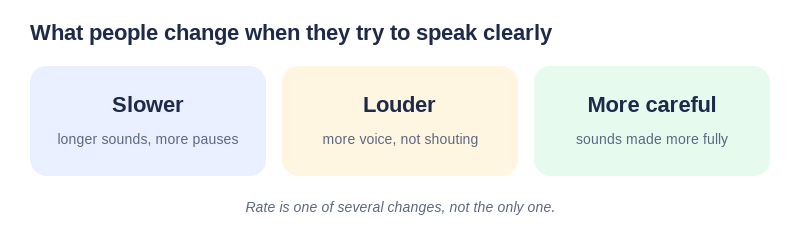
As the diagram shows, clear speech involves a wide range of adjustments rather than one. A review of the research found that talkers trying to be understood typically speak more slowly, more loudly and with more exaggerated articulation, with longer and more frequent pauses. Talkers trained to speak clearly at conversational rates still increased intelligibility for “normal-hearing” listeners with simulated hearing losses, in noise, though to a slightly smaller degree than clear speech at slow rates.1
Face them, get their attention, cut background noise
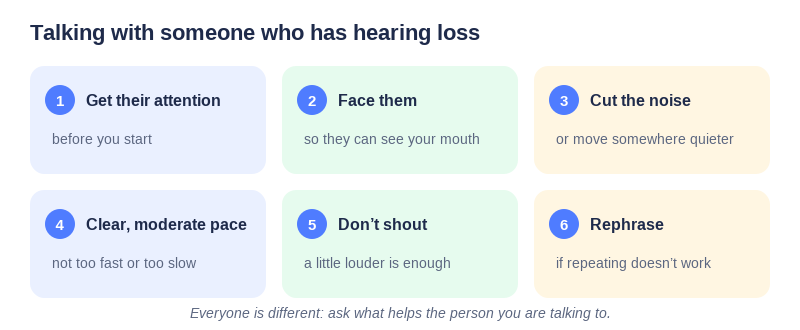
Get the listener’s attention before you start, face them, and don’t talk from another room. Lots of people rely on lipreading to some degree, so keep your mouth visible: don’t hide it, eat or chew gum while you talk. ASHA suggests sitting or standing 3–6 feet from the listener.5,6,2,4
Misunderstanding what people say, especially in noisy places, is one of the signs of hearing loss the NHS lists. Turn off or turn down background noise such as the TV, or find a quieter place to talk, especially in restaurants and at social gatherings. The Hearing Loss Association of America also flags phone calls, dimly lit rooms and strong backlighting as situations that can pose added difficulties.7,3,4,2,5
Pace, pauses and not shouting
The Hearing Loss Association of America advises speaking clearly at a moderate pace, without yelling. The National Institute on Aging suggests speaking “a little louder than normal” but not shouting, while ASHA suggests speaking clearly in your regular tone of voice, noting that shouting just makes it harder for the person with hearing loss to understand you. RNID asks people to avoid shouting, or speaking “too fast” or “unnecessarily slow”.5,2,4,6
Previous research supports the advice to speak more slowly: speech intelligibility improves for individuals with hearing loss when speaking rate is slower. In a study of 21 cochlear implant users, sentences slowed to 1.4 times their duration were slightly more intelligible and gave release from listening effort, particularly the effort that would have lingered after a sentence was over. The authors add that true clear speech would involve more than simple uniform stretching of speech.8
Where you pause matters too. In an experiment with 27 “normal-hearing” young adults, inserting silent pauses at linguistically meaningful points in sped-up speech brought recall accuracy back close to its level at the original rate, while pauses at random points gave little or no improvement. ASHA also suggests building breaks into a conversation, because people with hearing loss spend extra effort listening, which can cause fatigue.11,4
In one study, proficient non-native talkers who used clear speech in their second language became significantly more intelligible to both native and non-native listeners, while the presence of foreign accent stayed the same. The authors conclude that intelligibility and accentedness are two independent dimensions of speech.12
Rephrase rather than just repeat
If someone doesn’t understand you, RNID suggests repeating what you said or phrasing it differently, in plain language. The National Institute on Aging and ASHA also suggest saying it in different words. Be patient and respectful, and avoid dismissive comments such as “never mind”.6,2,4,5
RNID points out that not all people with hearing loss are the same, and different individuals may need different changes. The NHS and NIDCD both advise people with hearing loss to ask others to speak more slowly and clearly.6,7,3
- Ask how they’d like you to communicate, and remember the answer.
- If they ask you to slow down or speak more clearly, take the request at face value.
- Say the topic first, then the detail.
- Check the key point has landed, rather than asking “Did you hear me?”
- In a group, keep to one person talking at a time.
- Write down names, numbers and times when they matter.
Practising a clearer, steadier pace
A slower rate than usual and more vocal intensity are part of clear speech, but its focus is on hyperarticulation. In one study, 78 speakers read sentences in habitual, clear, loud and slow conditions; mixed with multitalker babble, the loud and clear versions improved intelligibility but the slow version didn’t, and for the study’s control speakers the slow condition was less intelligible than their habitual speech.13
The aim is controlled speech, not slower speech. If you want to understand your own pace, the free speaking rate test takes about 2 minutes: you read a short passage aloud, then talk freely for 30 seconds, and see each part’s rate in syllables per second side by side. It’s analysed on your device, the results are indicative, not a diagnosis, and the free-speech figure is approximate. Background noise can add or hide syllables, so record somewhere quiet and compare with your own earlier results rather than anyone else’s.
Free Speaking Rate Test
Read a short passage aloud, then talk freely for 30 seconds. Analysed on your device; indicative, not a diagnosis.
With a free account, SpeechStep Pacing adds steady reading, where a passage is highlighted at a steady guide pace, phrase pacing with marked pauses, and pause practice, and a re-test uses a matched passage so the change is comparable. The first two pacing sessions are free, then Premium. It doesn’t measure loudness or voice quality, so how loud you sound is something to check by asking your listener.
When to suggest a hearing check
The NHS lists signs of hearing loss such as finding it hard to keep up with a conversation and feeling tired or stressed from having to concentrate while listening. The National Institute on Aging includes finding it hard to follow conversations when two or more people are talking, and thinking that others seem to mumble.7,2
If you notice signs like these in someone you talk with often, raise it gently and suggest they talk to a doctor about a hearing check.
What SpeechStep can and can’t do
SpeechStep helps you practise your own speaking pace and pauses. It doesn’t test hearing or measure loudness, and its speaking rate test is indicative, analysed on your device and not a diagnosis. If you’re concerned about your own speech, a licensed speech-language pathologist (SLP) is the next step; the find-support page explains how to find one through your country’s register.
Frequently asked questions
How do you talk to someone with hearing loss?+
Get their attention first, face them so they can see your mouth, and find a quieter place to talk if you can. Speak clearly at a moderate pace without yelling. If they have difficulty understanding you, say it in a different way.
Should you speak louder to someone who is hard of hearing?+
The National Institute on Aging suggests “a little louder than normal”, but not shouting. ASHA suggests your regular tone of voice and notes that shouting just makes it harder for a person with hearing loss to understand you. Clear speech is generally accompanied by at least some increase in vocal intensity.
Does speaking slowly help people with hearing loss?+
In a study of 21 cochlear implant users, slowed sentences were slightly more intelligible and gave release from listening effort. RNID still advises against speaking unnecessarily slow, and the study’s authors note that true clear speech involves more than stretching speech out.
How should I speak to an elderly person with hearing loss?+
The National Institute on Aging suggests facing the person, speaking clearly and a little louder without shouting, finding a quiet place to talk, and repeating yourself in different words if necessary. In one study, older “normal-hearing” listeners were at a much greater disadvantage with naturally fast speech than sped-up recordings would predict. ASHA suggests building breaks into conversation, because people with hearing loss spend extra effort listening.
What is clear speech?+
Clear speech is a way of talking that people use on purpose to be easier to understand, for example in noise or with someone who has a hearing impairment. Talkers typically speak more slowly, more loudly and with more exaggerated articulation. In studies, clear speech was significantly more intelligible than conversational speech for listeners with hearing loss.
Can I check how fast I talk?+
SpeechStep’s free speaking rate test shows your rate in syllables per second for reading aloud and for talking freely. It’s analysed on your device and the results are indicative, not a diagnosis. Compare with your own earlier results rather than with other people.
Practise your own speech, one sound at a time
Free with an account: your first practice day is a full session of 14 words, then 5 words a day, with AI feedback on the sounds it supports. SpeechStep is practice, not therapy, and it doesn’t diagnose.
Need a licensed professional? Where to find a speech-language pathologist
References
14 sources from authoritative bodies. Last reviewed November 2026.
- 1.Language and Linguistics CompassSpeaking and Hearing Clearly: Talker and Listener Factors in Speaking Style Changes — Peer-reviewed review (PMC full text), 2009.
- 2.National Institute on Aging (NIH)Hearing Loss: A Common Problem for Older Adults — Patient information page, 2023.
- 4.ASHATips for Communicating With Someone Who Has Hearing Loss — Public tip sheet.
- 5.Hearing Loss Association of America (HLAA)Communication Tips: Tips to Hear and Be Heard — Patient organisation tip page, 2025.
- 6.RNID (Royal National Institute for Deaf People)How to communicate with someone who is deaf or has hearing loss — Charity information page, 2026.
- 7.NHS (nhs.uk)Hearing loss — Patient information page, 2025.
- 8.Ear and Hearing (Wolters Kluwer, open access); PMC8005496Slower Speaking Rate Reduces Listening Effort Among Listeners With Cochlear Implants (Winn & Teece) — Journal article, 2021.
- 9.Journal of Speech, Language, and Hearing Research (ASHA); NIH author manuscript PMC3370057Talker Differences in Clear and Conversational Speech: Vowel Intelligibility for Older Adults with Hearing Loss (Ferguson) — Journal article, 2012.
- 10.Journal of the Acoustical Society of America (JASA Express Letters); PMC6377055 (checker reads the abstract)Recognition of time-compressed speech does not predict recognition of natural fast-rate speech by older listeners (Gordon-Salant, Zion & Espy-Wilson) — Journal article (abstract excerpts), 2014.
- 11.Trends in Hearing (SAGE, open access); PMC10637151Strategic Pauses Relieve Listeners from the Effort of Listening to Fast Speech (O'Leary, Neukam, Hansen, Kinney, Capach, Svirsky & Wingfield) — Journal article, 2023.
- 12.Journal of the Acoustical Society of America; PMC3253601 (checker reads the abstract)Bidirectional clear speech perception benefit for native and high-proficiency non-native talkers and listeners: Intelligibility and accentedness (Smiljanić & Bradlow) — Journal article (abstract excerpts), 2011.
- 13.Journal of Speech, Language, and Hearing Research (ASHA); NIH author manuscript PMC5564324Impact of Clear, Loud, and Slow Speech on Scaled Intelligibility and Speech Severity in Parkinson’s Disease and Multiple Sclerosis (Tjaden, Sussman & Wilding) — Journal article, 2014.
- 14.Journal of Speech, Language, and Hearing Research (ASHA); NIH author manuscript PMC5564313Acoustics of Clear Speech: Effect of Instruction (Lam, Tjaden & Wilding) — Journal article, 2012.
Keep reading
How to Speak Clearly
Practical ways to be easier to understand in everyday talk.
Read →Pausing When Speaking
Where pauses help listeners, and how to practise them.
Read →Controlled Speech, Not Slower Speech
Why clarity is about control, not just speed.
Read →Talking Too Fast?
What makes speech feel rushed to listeners, and what you can practise.
Read →